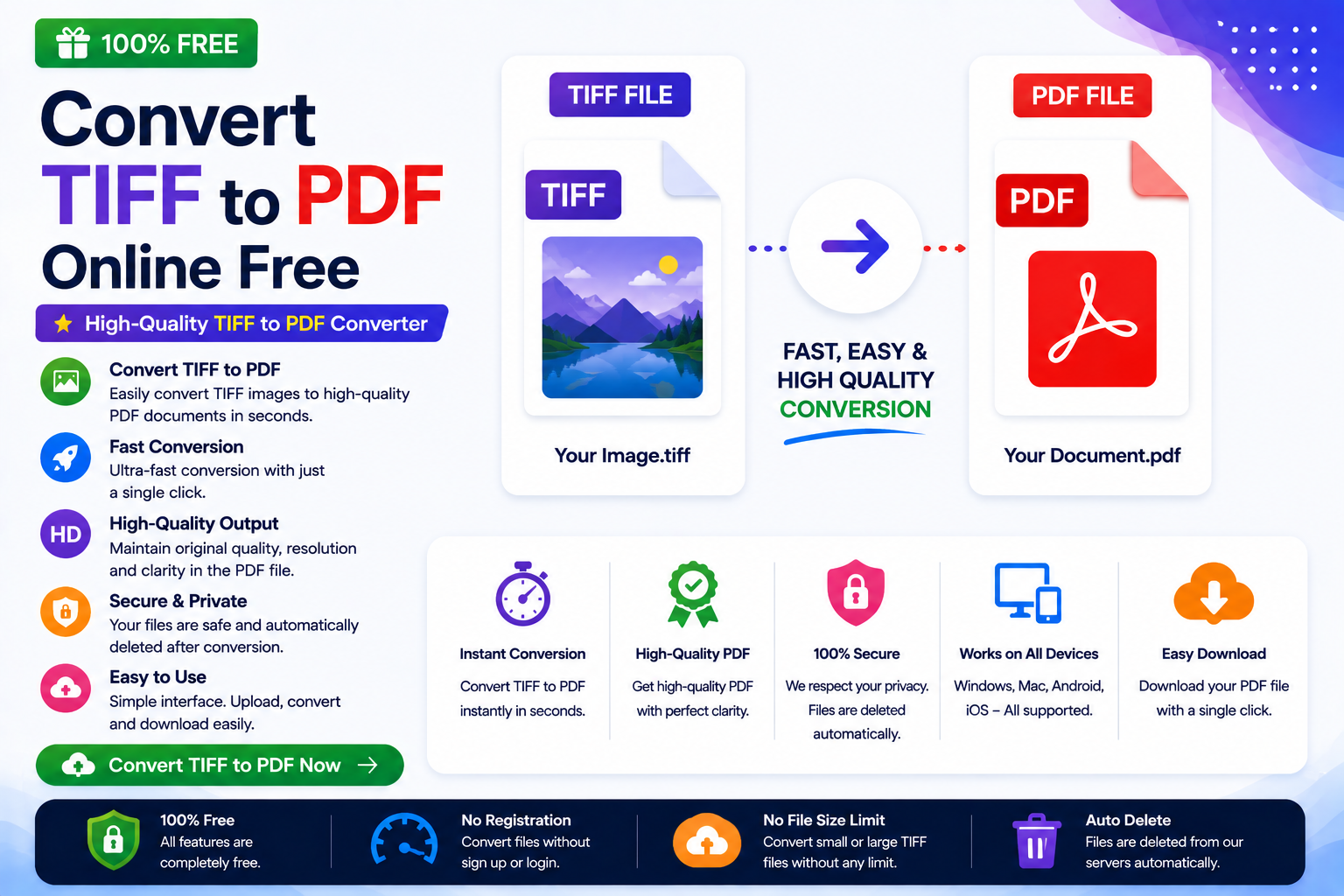
Digital documents and images are used everywhere—from educational institutions and businesses to hospitals, legal firms, and government offices. Among the many image formats available today, TIFF (Tagged Image File Format) is one of the most trusted formats for storing high-quality images.
TIFF files are widely used because they preserve image quality without sacrificing detail. They are commonly used in professional photography, document scanning, printing, publishing, medical imaging, engineering drawings, and archival systems.
However, despite their excellent quality, TIFF files are not always convenient for sharing. Many users cannot easily open TIFF files on mobile devices or web browsers, and some online portals do not accept TIFF uploads.
This is where Convert TIFF to PDF becomes extremely useful.
Convert TIFF to PDF to create a universally accepted document that is easier to share, print, archive, upload, and organize.
If you’re looking for a fast and secure solution, try the CodexJunction TIFF to PDF Converter:
👉 https://codexjunction.com/apps/tiff-to-pdf.html
This beginner-friendly guide explains everything you need to know about TIFF to PDF conversion, including how it works, why it’s useful, and when you should use it.
Convert TIFF to PDF online when you need to turn high-quality TIFF images into widely supported PDF documents for sharing, printing, archiving, and online submissions.
What Is a TIFF File?
TIFF (Tagged Image File Format) is a high-quality image format developed for storing detailed graphics and scanned documents.
Unlike JPG images that use lossy compression, TIFF files usually preserve all image information.
This makes TIFF ideal for:
- Professional photography
- Document scanning
- Medical imaging
- Printing
- Publishing
- Graphic design
- Engineering drawings
- Archival storage
TIFF files commonly use these extensions:
.tif.tiff
Both represent the same format.
What Is a PDF File?
PDF (Portable Document Format) is one of the world’s most popular document formats.
PDF was designed to preserve document layout regardless of the operating system or software used.
A PDF can contain:
- Images
- Text
- Tables
- Forms
- Hyperlinks
- Multiple pages
PDF files work consistently on:
- Windows
- macOS
- Linux
- Android
- iPhone
- Tablets
- Web browsers
This makes PDF the preferred format for professional document sharing.
Why Convert TIFF to PDF?
Although TIFF images provide exceptional quality, they are not always practical.
Reasons to convert TIFF into PDF include:
Better Compatibility When You Convert TIFF to PDF
Most devices open PDF files without additional software.
Easier Sharing When You Convert TIFF to PDF
A PDF document is simpler to email and upload.
Professional Appearance
PDF files are widely accepted in offices, universities, banks, hospitals, and government organizations.
Better Printing After You Convert TIFF to PDF
PDF preserves page layout and image positioning.
Multi-page Documents
Multiple TIFF images can be combined into a single PDF.
Try the Free TIFF to PDF Converter
Need to convert TIFF images into PDF?
Use the CodexJunction TIFF to PDF Converter.
👉 https://codexjunction.com/apps/tiff-to-pdf.html
Features include:
- Free online conversion
- No software installation
- Browser-based tool
- Fast processing
- High-quality PDF output
- Secure file handling
- Mobile-friendly interface
How to Convert TIFF to PDF
The TIFF to PDF process is simple.
Step 1 – Upload TIFF Images
Choose one or multiple TIFF files.
Step 2 – Arrange Images
Organize pages if necessary.
Step 3 – Convert
The TIFF images are embedded into PDF pages.
Step 4 – Download
Save the generated PDF document.
The entire process usually takes only a few seconds.
TIFF vs PDF
| FeatureTIFFPDF | ||
|---|---|---|
| File Type | Image | Document |
| Multiple Pages | Supported | Supported |
| Easy Sharing | Moderate | Excellent |
| Printing | Excellent | Excellent |
| Browser Support | Limited | Excellent |
| Mobile Friendly | Moderate | Excellent |
| Universal Compatibility | Limited | Excellent |
Benefits of TIFF to PDF Conversion
TIFF to PDF conversion offers many advantages.
Better File Organization
Store multiple scanned images in one document.
Easier Document Submission
Most educational and government portals accept PDF, so you can Convert TIFF to PDF before submitting documents.
Better Email Compatibility
PDF documents are easier to attach than several TIFF images when you Convert TIFF to PDF.
Improved Accessibility
PDF works across nearly every device.
Long-Term Archiving
PDF is widely used for preserving digital records, which makes Convert TIFF to PDF useful for archiving.
Common Use Cases
TIFF to PDF conversion is commonly used for:
- Scanned documents
- Legal paperwork
- Medical reports
- Engineering drawings
- Architectural plans
- Historical archives
- Business contracts
- Educational assignments
- Identity documents
- Research papers
TIFF to PDF for Students
Students frequently scan:
- Assignments
- Certificates
- Project reports
- Notes
Combining TIFF images into one PDF makes submission easier.
TIFF to PDF for Businesses
Businesses use TIFF to PDF for:
- Employee records
- Contracts
- Product documentation
- Customer files
- Financial reports
PDF simplifies storage and sharing.
TIFF to PDF for Hospitals
Medical organizations often store:
- X-rays
- Scanned reports
- Medical documentation
Converting TIFF images into PDF improves accessibility.
TIFF to PDF for Legal Professionals
Law firms frequently archive:
- Contracts
- Evidence
- Case files
- Signed agreements
PDF provides organized documentation.
TIFF to PDF for Developers
Software developers often scan:
- Wireframes
- UI mockups
- Documentation
- System diagrams
Combining them into PDF simplifies project documentation.
Why PDF Is Preferred
PDF has become the standard document format because it offers:
- Consistent layout
- Universal compatibility
- Easy printing
- Multi-page support
- Professional presentation
Almost every business relies on PDF.
Multi-page TIFF to PDF
One important advantage is handling multiple pages.
A multi-page TIFF file can easily become a multi-page PDF.
This improves:
- Navigation
- Sharing
- Printing
- Archiving
Does TIFF to PDF Reduce Quality?
No.
A good converter preserves the original image quality.
The TIFF image is simply placed inside the PDF document.
Is TIFF Better Than PDF?
Not necessarily.
Each format serves a different purpose.
TIFF
Best for:
- Editing
- Printing
- Image preservation
- Professional graphics
Best for:
- Sharing
- Printing
- Documentation
- Online submissions
- Archiving
Is TIFF to PDF Safe?
Yes.
Using browser-based converters allows secure conversion without software installation.
Trusted tools like CodexJunction provide a reliable experience.
Best Practices Before Converting TIFF to PDF
For additional image optimization guidance, see Google’s image optimization guide.
For the best results:
- Use high-resolution TIFF images.
- Remove duplicate scans.
- Arrange pages correctly.
- Rotate images if necessary.
- Keep original TIFF files as backups.
Common Mistakes Beginners Make
Avoid these mistakes.
Uploading Images in the Wrong Order
Arrange pages before conversion.
Scanning at Very Low Resolution
Higher resolution produces better PDFs.
Forgetting Page Orientation
Rotate images before converting.
Deleting Original TIFF Files
Always keep backup copies.
Can I Merge Multiple TIFF Images When I Convert TIFF to PDF?
Yes.
One PDF document can contain:
- One TIFF image
- Multiple TIFF files
- Multi-page scanned documents
This is one of the biggest advantages of PDF.
Can TIFF Files Contain Multiple Pages?
Yes.
Unlike JPG or PNG, TIFF files can store multiple pages inside one image file.
Converting them into PDF preserves this document structure.
Frequently Asked Questions About TIFF to PDF
What is TIFF?
TIFF is a high-quality image format widely used for professional scanning, photography, and document storage.
What is PDF?
PDF is a document format designed to preserve formatting across devices.
Can I convert TIFF to PDF online?
Yes.
The CodexJunction TIFF to PDF Converter works directly in your browser.
Is TIFF to PDF free?
Yes.
The converter is completely free.
Will image quality decrease?
No.
A quality converter preserves the original TIFF image.
Can I use the converter on mobile?
Yes.
It works on Android, iPhone, tablets, laptops, and desktop computers.
Do I need software?
No.
Everything works online.
Related Tools on CodexJunction
If you regularly work with images and documents, explore these helpful tools available on CodexJunction.
PDF Tools
- TIFF to PDF Converter
- JPG to PDF Converter
- PNG to PDF Converter
- BMP to PDF Converter
- PDF to JPG Converter
- PDF Compressor
- PDF Merger
- PDF Splitter
Image Conversion Tools
- PNG to JPG Converter
- JPG to PNG Converter
- JPG to WebP Converter
- PNG to WebP Converter
- WebP to JPG Converter
- AI to JPG Converter
- Image Compressor
- Image Resizer
Other Utilities
- TXT to JPG Converter
- MOV to JPG Converter
- JPG to ZIP Converter
- QR Code Generator
- File Conversion Tools
Learn Programming with CodexJunction
CodexJunction is not just an online converter platform.
It also provides beginner-friendly learning resources including:
- HTML Tutorial
- CSS Tutorial
- JavaScript Tutorial
- TypeScript Guide
- React.js Tutorial
- Next.js Guide
- Node.js Tutorial
- Express.js Tutorial
- Python Programming
- Java Programming
- C Programming
- C++ Tutorial
- SQL Tutorial
- MongoDB Guide
- Git & GitHub Tutorials
- Data Structures & Algorithms (DSA)
- Frontend Development Roadmap
- Backend Development Roadmap
- Full Stack Development Guide
- Technical SEO Tutorials
- Core Web Vitals Explained
- Website Performance Optimization
- Image Optimization Techniques
- Technical Interview Questions
These tutorials are designed to help students, freshers, and professionals develop practical skills in programming, web development, and software engineering.
Why Choose the CodexJunction TIFF to PDF Converter?
The CodexJunction TIFF to PDF Converter is built for speed, reliability, and ease of use.
Benefits include:
- Completely free
- Browser-based conversion
- No registration required
- No software installation
- High-quality PDF output
- Beginner-friendly interface
- Fast processing
- Secure file handling
- Compatible with Windows, macOS, Linux, Android, and iOS
Whether you’re converting one TIFF image or hundreds of scanned pages, the tool provides consistent results.
Convert TIFF to PDF Online Now
Ready to convert your TIFF images into professional PDF documents?
Use the CodexJunction TIFF to PDF Converter:
👉 https://codexjunction.com/apps/tiff-to-pdf.html
No installation.
No registration.
Fast conversion.
Secure browser-based processing.
Perfect for students, businesses, hospitals, legal professionals, engineers, and everyday users.
Final Thoughts
TIFF is one of the most reliable image formats for preserving high-quality graphics and scanned documents. It is widely used in industries where image accuracy matters, such as healthcare, publishing, engineering, and legal services. However, TIFF files are not always convenient for sharing or submitting online.
Convert TIFF to PDF to combine the high-quality content of TIFF images with the universal compatibility and professional presentation of PDF documents. A PDF is easier to email, print, archive, upload, and organize while preserving the original appearance of your scanned pages or graphics.
Whether you’re a student submitting assignments, a business managing records, a healthcare professional organizing reports, a legal expert handling case files, or a developer creating documentation, the CodexJunction TIFF to PDF Converter offers a fast, secure, and beginner-friendly solution.
With no software installation, no registration, and quick browser-based processing, you can convert TIFF images into high-quality PDF documents in just a few clicks. Explore the other free image converters, PDF utilities, and programming tutorials on CodexJunction to simplify your workflow and continue building your technical skills.