
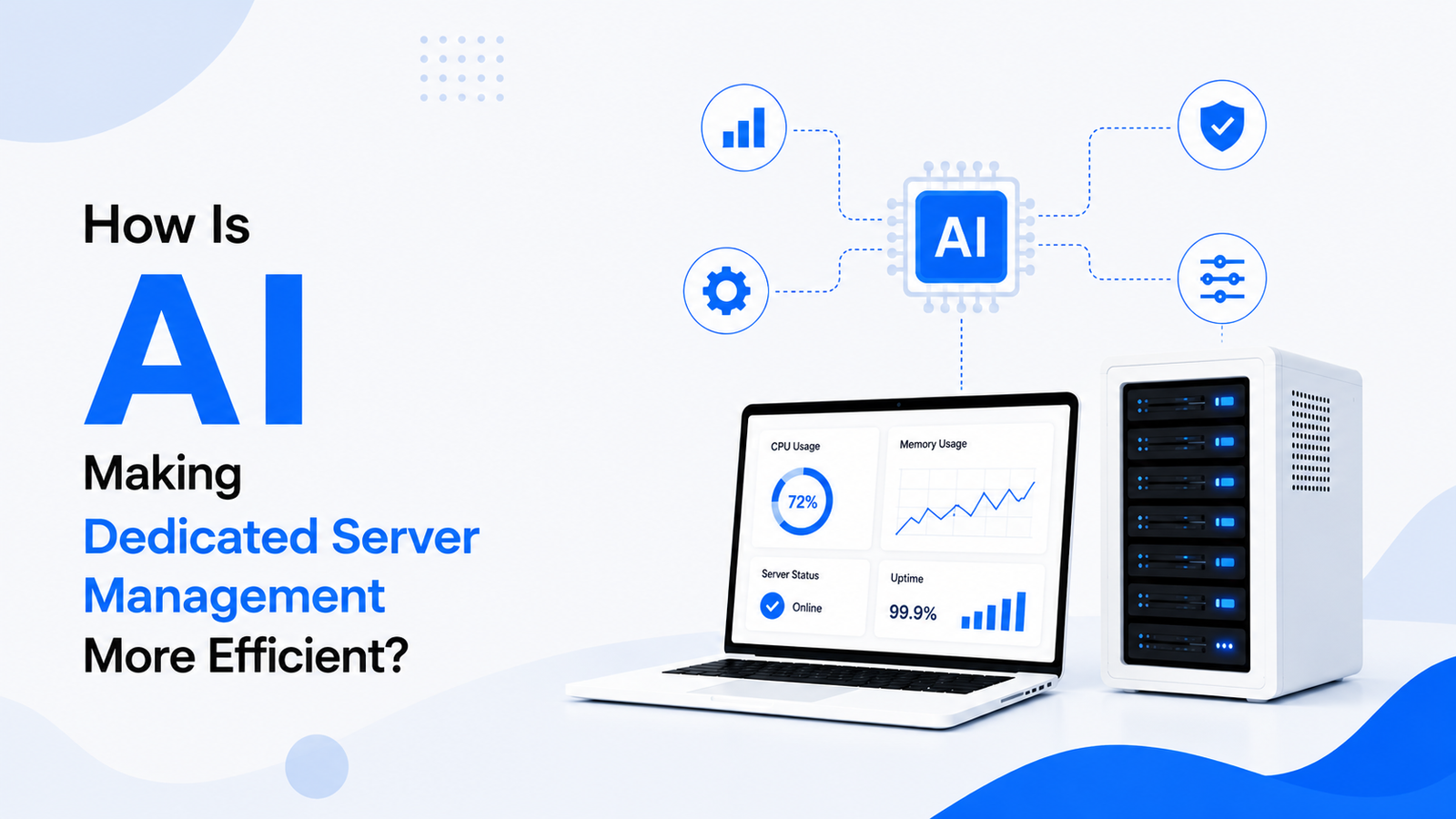
How AI Server Management Is Making Dedicated Servers More Efficient
AI server management is changing how businesses monitor, secure, optimize, and maintain dedicated servers. Traditional server management often requires continuous monitoring, manual intervention, and reactive troubleshooting. AI can help teams identify problems earlier, automate repetitive operations, optimize resources, and respond to potential threats more efficiently.
As businesses increasingly depend on websites, applications, databases, and online services, reliable server infrastructure has become essential. AI-powered server management provides a smarter approach by combining automation, predictive intelligence, real-time monitoring, and intelligent resource allocation.
In this article, we’ll explore how AI server management is making dedicated servers more efficient, secure, reliable, and cost-effective.
What Is AI Server Management?
AI server management refers to using artificial intelligence and machine learning technologies to monitor, analyze, optimize, and automate server operations.
Instead of relying entirely on manual checks and fixed monitoring rules, AI can analyze server behavior and identify patterns in areas such as:
- CPU usage
- RAM consumption
- Disk utilization
- Network traffic
- Server performance
- Login activity
- Security events
- Application behavior
- System errors
By continuously analyzing this information, AI server management systems can help IT teams detect unusual behavior and respond before small issues become major problems.
How AI Is Improving Dedicated Server Management
1. Predictive Maintenance Prevents Server Problems
One of the biggest advantages of AI server management is predictive maintenance.
Traditional server maintenance often happens after a problem has already occurred. A server crashes, an application becomes unavailable, or storage reaches capacity, and the IT team then starts troubleshooting.
AI takes a more proactive approach.
Machine learning systems can analyze historical and real-time server data to identify unusual patterns in CPU activity, memory consumption, disk usage, and other performance indicators.
For example, if a server’s resource consumption gradually changes in a way that previously occurred before a failure, an AI system can alert administrators to investigate the problem.
This allows businesses to address potential issues before they result in serious downtime.
2. Automated 24/7 Server Monitoring
Dedicated servers require continuous monitoring.
Manually checking server logs, resource usage, network activity, and system health can consume significant time. AI server management can automate much of this monitoring process.
AI-powered monitoring systems can continuously analyze:
- CPU utilization
- Memory usage
- Storage capacity
- Network traffic
- Application performance
- Error logs
- Security events
Instead of generating alerts for every small variation, intelligent monitoring can identify unusual behavior and prioritize more meaningful events.
This helps IT teams focus on issues that actually require attention rather than spending hours reviewing unnecessary alerts.
3. Intelligent Resource Optimization
Server resources are not always used consistently.
A website may receive normal traffic during most hours and experience a sudden increase during a marketing campaign, product launch, or peak business period.
AI server management can analyze resource consumption and identify usage patterns.
Based on these patterns, AI can help optimize the allocation of:
- CPU resources
- RAM
- Storage
- Bandwidth
- Processing capacity
This can help businesses maintain performance during high-demand periods while avoiding unnecessary resource consumption during low-demand periods.
Efficient resource management can also help reduce operational costs.
4. Enhanced Server Security
Security is another important area where AI can improve server management.
AI-powered security systems can analyze login attempts, network behavior, access patterns, and other server activity to identify unusual behavior.
For example, an unusual increase in failed login attempts may indicate a potential brute-force attack. Similarly, unexpected network activity could require further investigation.
AI can help identify patterns associated with potential threats such as:
- Brute-force attacks
- Suspicious login behavior
- Malware activity
- Unusual network traffic
- Potential DDoS activity
AI should not replace established security controls, but it can provide an additional layer of monitoring and analysis that helps security teams respond faster.
5. Self-Healing and Automated Recovery
Another potential benefit of AI server management is automated remediation.
Some server problems are caused by temporary service failures, configuration issues, or processes that stop unexpectedly.
When properly configured, automated systems can detect certain known problems and perform predefined recovery actions.
For example, an automated system could restart a failed service or execute a predefined recovery procedure when a specific condition is detected.
This can reduce the amount of manual intervention required and help minimize downtime.
However, automated remediation should be carefully controlled. Critical server changes should have appropriate safeguards, logging, testing, and human oversight.
6. Smarter Backups and Disaster Recovery
Backups are essential for protecting business data.
Traditional backup systems can be configured to run at fixed intervals. AI can make backup management more intelligent by analyzing data usage, system activity, and business requirements.
AI-assisted backup systems can help determine:
- When backups should run
- Which data requires priority
- How frequently important data should be backed up
- Which backups should be retained
- Which systems should receive priority during recovery
During a disaster recovery situation, intelligent prioritization can help teams focus on restoring business-critical systems first.
This can reduce recovery time and help limit the impact of system failures.
7. Lower Operational Costs
AI server management can also help reduce unnecessary operational costs.
Businesses sometimes allocate more server capacity than they actually need because they want to prepare for unexpected traffic or workload increases.
AI can analyze historical and real-time resource usage to help administrators make better decisions about capacity.
By identifying underused resources and workload patterns, businesses can potentially reduce unnecessary infrastructure consumption.
For larger environments, intelligent workload management and resource optimization can produce significant operational benefits.
8. Faster Troubleshooting and Problem Detection
Finding the cause of a server problem can be time-consuming.
Administrators may need to review logs, resource graphs, error messages, network activity, and application behavior before identifying the underlying issue.
AI can analyze large amounts of operational data much faster than manual processes.
It can identify relationships between different events and highlight unusual patterns that may otherwise be difficult to notice.
This can help IT teams investigate problems more efficiently and reduce the time required for troubleshooting.
AI Server Management vs Traditional Server Management
Traditional server management relies heavily on manual monitoring, predefined thresholds, and reactive troubleshooting.
AI server management introduces more intelligent analysis and automation.
| Feature | Traditional Management | AI Server Management |
|---|---|---|
| Monitoring | Manual or rule-based | Intelligent and continuous |
| Maintenance | Often reactive | More proactive |
| Resource allocation | Manually configured | Data-driven optimization |
| Security monitoring | Rules and signatures | Behavioral analysis plus existing controls |
| Troubleshooting | Manual investigation | AI-assisted analysis |
| Alerts | Can generate many alerts | Can prioritize anomalies |
| Recovery | Manual or predefined | Can support automated remediation |
| Scalability | Requires more manual management | More automation and intelligence |
AI does not eliminate the need for IT professionals. Instead, it can help teams manage infrastructure more efficiently.
Benefits of AI Server Management
Businesses can benefit from AI-powered server management in several ways:
- Reduced manual workload
- Faster problem detection
- Better resource utilization
- Improved server reliability
- More efficient security monitoring
- Reduced unnecessary downtime
- Faster troubleshooting
- Better backup management
- Potential cost savings
- Improved operational scalability
The actual benefits depend on the AI tools, infrastructure, configuration, workload, and level of automation being used.
Who Can Benefit From AI Server Management?
AI server management can be useful for different types of organizations.
Businesses With High-Traffic Websites
Websites receiving large amounts of traffic need reliable infrastructure and continuous performance monitoring.
eCommerce Businesses
Online stores depend on server availability, especially during sales, promotions, and seasonal traffic peaks.
SaaS Companies
SaaS applications often require continuous monitoring and reliable infrastructure to maintain service availability.
Developers and IT Teams
Development and infrastructure teams can use AI-assisted monitoring and troubleshooting to reduce repetitive operational tasks.
Growing Businesses
As businesses expand, server infrastructure can become more complex. Automation can help teams manage larger environments without increasing manual work at the same rate.
Challenges of AI Server Management
Although AI offers significant advantages, businesses should also understand its limitations.
AI systems can produce incorrect recommendations or misunderstand unusual situations. Automated actions can also create problems if they are poorly configured.
Businesses should therefore implement:
- Human oversight
- Access controls
- Audit logs
- Testing environments
- Backup and recovery procedures
- Clear automation rules
- Security policies
- Regular monitoring of AI decisions
AI should be used as an intelligent management and decision-support layer rather than blindly allowing it to make every critical infrastructure decision.
How to Implement AI Server Management
Businesses considering AI server management can start with a gradual approach.
Step 1: Monitor Server Performance
Collect information about CPU, RAM, storage, network traffic, and application performance.
Step 2: Identify Repetitive Tasks
Determine which server management activities consume the most manual effort.
Step 3: Introduce Intelligent Alerts
Use monitoring systems to identify unusual patterns and prioritize important alerts.
Step 4: Automate Low-Risk Tasks
Start with safe and predictable operations such as routine checks, notifications, and predefined maintenance tasks.
Step 5: Add Predictive Monitoring
Use historical data to identify patterns that may indicate future performance or availability problems.
Step 6: Expand Automation Carefully
Once automated processes have been tested and validated, gradually introduce more advanced remediation and optimization capabilities.
The Future of AI Server Management
AI is likely to play an increasingly important role in infrastructure management.
As AI systems become more capable, server management can become more predictive and automated. Instead of simply reporting that something has gone wrong, intelligent systems can help identify why it happened, estimate its potential impact, and recommend appropriate actions.
This could lead to infrastructure environments that are:
- More automated
- More proactive
- More secure
- More efficient
- Easier to scale
- More resilient
However, human expertise will remain important for architecture, security decisions, risk management, compliance, and complex infrastructure changes.
Conclusion
AI server management is transforming the way businesses operate dedicated server infrastructure.
From predictive maintenance and automated monitoring to intelligent resource optimization, security analysis, backup management, and automated recovery, AI can reduce repetitive work while helping IT teams respond to infrastructure problems more quickly.
The biggest advantage is not simply automation. It is the ability to analyze large amounts of server data, identify patterns, and provide actionable insights that help businesses make better infrastructure decisions.
For organizations running websites, applications, eCommerce platforms, SaaS products, or other online services, combining dedicated servers with intelligent AI-assisted management can create a more efficient and reliable infrastructure strategy.
AI will not completely replace server administrators. Instead, it can give them better tools to monitor infrastructure, identify risks, optimize resources, and focus their time on higher-value technical work.

CodexJunction Editorial Team creates practical and easy-to-understand technology content covering programming, web development, AI, APIs, cybersecurity, WordPress, hosting, technical SEO, and related technology topics.
The team focuses on clear explanations, useful examples, reliable research, and keeping technical information relevant and up to date.