
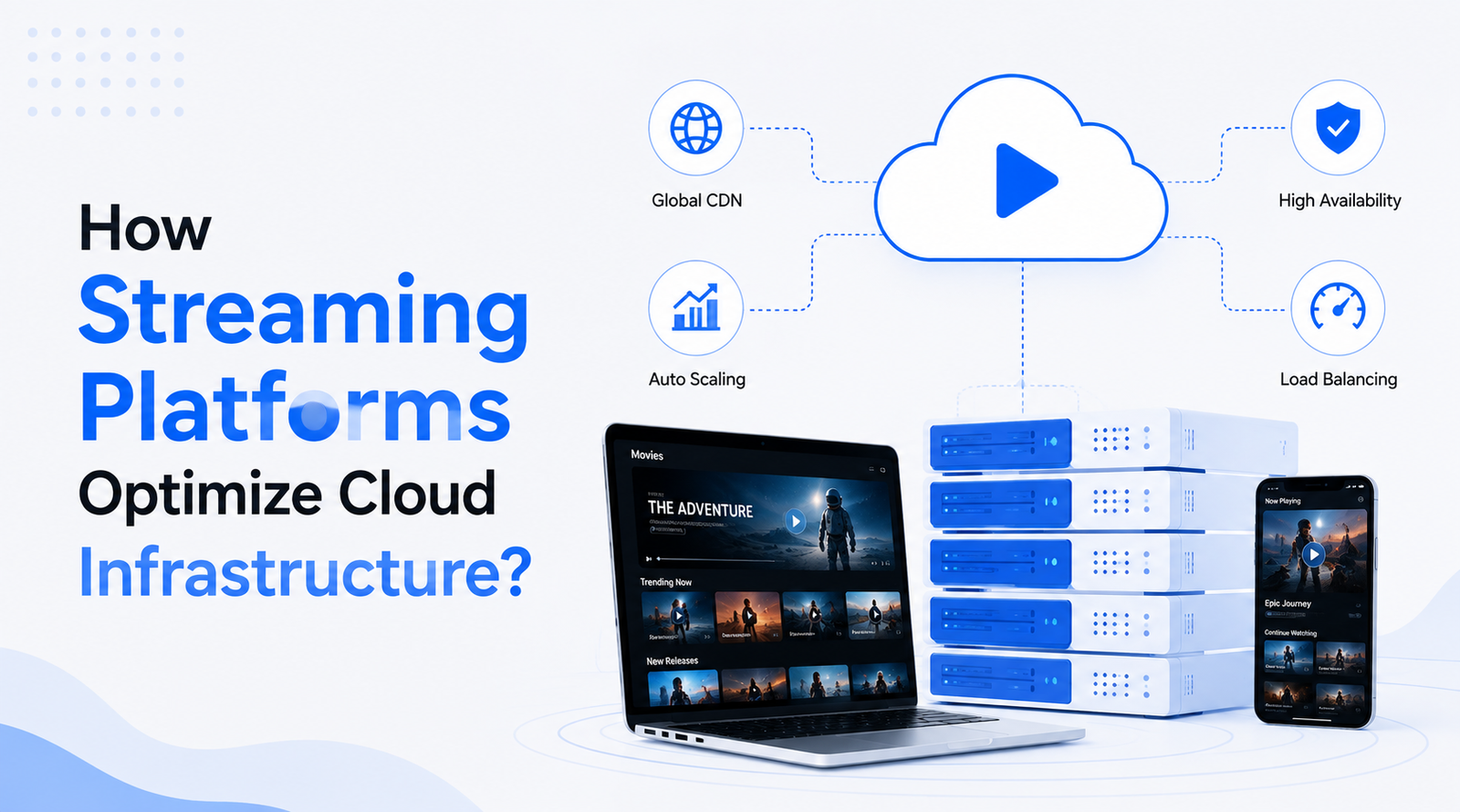
Cloud infrastructure has become essential for handling unpredictable, high-volume demand. A single hour of 4K video can push close to 7GB of data across a network. Multiply that by millions of viewers tuning into a live sports final, and the numbers become overwhelming fast.
Streaming platforms solved this challenge years before most industries noticed it, building infrastructure capable of handling massive traffic without buffering a single frame. Their approach provides a useful blueprint for businesses researching cloud infrastructure that can handle unpredictable traffic, control costs, and maintain reliable performance.
The same principles extend beyond entertainment. Managed service providers handling multiple client workloads face a smaller version of the same challenge: unpredictable spikes, restricted budgets, and zero tolerance for downtime. Studying how streaming platforms architect their backends reveals practical patterns that can be applied to websites, SaaS applications, e-commerce platforms, APIs, and other business systems.
This article explores five important lessons from streaming platforms and explains how businesses can apply them to build more reliable and scalable cloud infrastructure.
Elastic Scaling Architecture for Cloud Infrastructure
Streaming platforms handle traffic that can change dramatically within minutes. A popular series release, major sporting event, or highly anticipated movie can suddenly bring millions of additional users to the platform.
Instead of maintaining a fixed number of servers at all times, large streaming platforms use elastic infrastructure. Computing resources can increase when demand rises and decrease when traffic returns to normal.
Netflix and similar platforms run thousands of microservices, allowing different parts of their applications to scale independently. A service experiencing heavy demand does not necessarily require every other service to scale at the same rate.
For businesses, this approach is particularly useful because traffic rarely remains constant throughout the day.
An e-commerce website might receive normal traffic during the morning, experience a significant increase during lunchtime, and then see another spike during an evening promotion. A SaaS application could experience a similar pattern when a large customer begins onboarding hundreds or thousands of users.
A fixed infrastructure model requires businesses to choose between two difficult options. They can purchase enough capacity to handle the largest expected traffic spike, leaving expensive resources unused during quieter periods, or they can operate with minimal capacity and risk slowdowns when traffic suddenly increases.
Elastic cloud infrastructure provides a better alternative.
Resources can be increased when demand crosses a predefined threshold and reduced when demand falls. Automated monitoring systems can trigger scaling based on metrics such as CPU utilization, memory usage, request rates, response times, or active users.
Businesses can also prepare for predictable traffic events in advance.
For example, an online retailer expecting a major seasonal sale can increase capacity before the event begins. This is much safer than waiting for traffic to increase and attempting to solve infrastructure problems after users are already experiencing slow performance.
The main lesson is simple: infrastructure should respond to demand instead of forcing the business to operate with the same capacity all year.
Global Edge Delivery and Cloud Infrastructure
Distance matters when delivering digital content.
A user accessing a website from Mumbai should ideally receive content from infrastructure located relatively close to them rather than requesting every asset from an origin server located thousands of miles away.
Streaming platforms solve this problem using globally distributed edge infrastructure and content delivery networks.
Edge servers store frequently requested content closer to users. When someone requests a video, image, stylesheet, JavaScript file, or other cached resource, the content can often be delivered from a nearby location instead of traveling all the way back to the origin.
This reduces latency and also decreases the amount of traffic reaching the primary infrastructure.
For streaming services, this architecture is especially important because video files are large. Delivering every video directly from a central origin server would create enormous network and processing requirements.
Instead, content can be distributed across edge locations and served closer to viewers.
The same principle works for businesses.
An online store can cache product images and static resources at edge locations. A SaaS application can use distributed delivery for static assets. A content website can cache frequently requested pages and media.
For businesses using cloud infrastructure, edge delivery can provide several benefits:
- Faster page and content delivery
- Reduced latency
- Lower origin-server traffic
- Better performance for geographically distributed users
- Improved scalability during traffic spikes
- Reduced pressure on application servers
Caching also plays an important role.
Not every request needs to reach the application database. If a piece of content rarely changes, it can often be cached for a period of time. This allows the infrastructure to serve repeated requests efficiently.
A well-designed caching strategy therefore becomes an important part of scalable infrastructure.
Redundancy and Failover in Cloud Infrastructure
No infrastructure is completely immune to failure.
Servers can stop responding. Networks can experience problems. Databases can become unavailable. Software deployments can introduce unexpected issues. Even entire data centers can experience outages.
Streaming platforms design their infrastructure around this reality.
Instead of assuming that every component will remain available indefinitely, engineering teams build redundancy into critical systems.
Parallel infrastructure can operate across multiple availability zones or locations. If one component fails, another component can continue handling requests.
Health checks continuously monitor services and infrastructure components. When a system becomes unhealthy, traffic can be redirected away from it.
This approach prevents one failure from becoming a complete application outage.
For businesses, redundancy can be implemented at different levels depending on the application’s requirements and budget.
A small business website may not require the same level of redundancy as a global streaming platform. However, the underlying principle remains useful.
Businesses can consider:
- Automated backups
- Multiple application instances
- Database replication
- Load balancing
- Multiple availability zones
- Health monitoring
- Automated failover
- Disaster recovery procedures
The goal is not necessarily to eliminate every possible failure. Instead, the goal is to ensure that one failure does not bring down the entire service.
Streaming companies also treat failure testing as an important part of infrastructure management. Engineers can simulate failures to determine whether systems actually recover as expected.
This is an important lesson for businesses.
Having a backup system is not enough. Teams should understand how the system behaves when the primary service fails.
A backup that has never been tested may not provide the protection a business expects.
Reliable cloud infrastructure therefore combines redundancy, monitoring, backup systems, and tested recovery procedures.
Smart Resource Allocation for Cloud Infrastructure
Running every component on premium, always-on infrastructure can become expensive quickly.
Streaming platforms handle enormous workloads, so efficient resource allocation is critical. Engineering teams need to determine which resources should remain available continuously and which workloads can use flexible or temporary capacity.
One approach is to combine different types of infrastructure based on workload requirements.
Steady workloads can use predictable capacity, while temporary increases can use more flexible resources. This helps businesses avoid paying for maximum capacity when they only need it occasionally.
The same principle can be applied to smaller businesses.
Consider a website that normally receives 10,000 visits per day but occasionally receives 100,000 visits because of a successful marketing campaign.
Provisioning the infrastructure permanently for 100,000 daily visitors may waste money during most of the year.
Instead, businesses can build infrastructure that expands when demand increases and returns to normal when traffic decreases.
Monitoring is essential for making this model work.
Businesses should track:
- CPU usage
- Memory consumption
- Storage utilization
- Network traffic
- Database performance
- Request volume
- Response time
- Error rates
- Resource costs
These metrics provide visibility into how infrastructure is actually being used.
Without monitoring, businesses often make infrastructure decisions based on assumptions rather than real usage data.
Cost optimization should also avoid sacrificing reliability.
Choosing the cheapest possible infrastructure is not always the best strategy. A low-cost server that regularly becomes overloaded can create more expensive problems through lost sales, poor user experience, support requests, and downtime.
The objective is to find the right balance between performance, reliability, scalability, and cost.
This is where modern cloud infrastructure can be particularly useful. Businesses can adjust resources as their requirements change instead of committing permanently to a single infrastructure configuration.
Applying Cloud Infrastructure Lessons to Businesses
Few businesses need Netflix-scale infrastructure. However, almost every growing digital business can benefit from the architectural principles used by large streaming platforms.
A regional e-commerce store during a flash sale can experience the same type of traffic spike that a streaming service experiences during a major release, just at a smaller scale.
A SaaS company onboarding a large enterprise customer may suddenly experience a significant increase in API requests, database activity, and user sessions.
An agency managing dozens of client websites may need reliable infrastructure that can continue operating even when one component experiences a failure.
The scale is different, but the underlying problems are remarkably similar.
E-Commerce Businesses
Online stores need infrastructure that can handle sudden increases in traffic.
Sales campaigns, product launches, advertisements, and seasonal events can all generate unexpected demand.
Elastic scaling and caching can help an e-commerce website handle these situations without permanently maintaining maximum infrastructure capacity.
Static assets such as product images, stylesheets, and scripts can also benefit from edge delivery.
SaaS Applications
SaaS platforms often have unpredictable usage patterns.
One customer may have a small number of users, while another enterprise customer may introduce thousands of users at once.
Cloud infrastructure can allow application resources to scale according to actual usage.
Monitoring and automated alerts can also help engineering teams identify performance problems before they become major outages.
Managed Service Providers
Managed service providers face another important challenge: multiple clients can have completely different traffic patterns.
One client may operate a high-traffic e-commerce website while another runs a low-traffic business website.
Using scalable infrastructure allows providers to allocate resources according to individual requirements rather than treating every workload identically.
The same principles of monitoring, redundancy, backups, caching, and automated scaling can be applied across multiple client environments.
Content and Media Websites
Content websites can experience sudden traffic spikes when an article becomes popular on social media or is mentioned by a major publication.
A website designed only for normal traffic may struggle when thousands of visitors arrive simultaneously.
Caching and edge delivery can reduce the amount of work required from the origin infrastructure.
This allows the application to continue serving visitors even when traffic increases significantly.
Building a Scalable Cloud Infrastructure Strategy
Businesses should not copy the entire architecture of a large streaming platform. Instead, they should identify which principles actually solve their own problems.
A practical strategy can begin with five questions.
1. What Does Normal Traffic Look Like?
Start by understanding normal usage.
Determine how many users, requests, transactions, or page views the application receives during an average period.
This creates a baseline for infrastructure planning.
2. What Causes Traffic Spikes?
Next, identify events that can increase demand.
These might include:
- Marketing campaigns
- Product launches
- Seasonal sales
- Social media exposure
- New customer onboarding
- Live events
- Advertising campaigns
Understanding these patterns makes capacity planning much easier.
3. Which Resources Can Be Cached?
Not every request needs to reach the application server.
Static assets and frequently requested content can often be cached. This reduces application workload and improves response times.
4. What Happens When Something Fails?
Businesses should document their recovery process.
Ask what happens if:
- The main server becomes unavailable.
- The database fails.
- A network connection is interrupted.
- A deployment introduces an error.
- A storage system becomes unavailable.
The answers reveal where redundancy and recovery systems are required.
5. How Much Does Infrastructure Actually Cost?
Finally, track infrastructure spending against actual resource usage.
Businesses should know which resources consume the most money and whether those resources are being used efficiently.
This makes it easier to identify opportunities for optimization without compromising reliability.
Why Cloud Infrastructure Matters for Growing Businesses
Infrastructure decisions made when a business is small can become significant limitations as the company grows.
A website that works perfectly with a few hundred daily visitors may struggle when traffic reaches tens of thousands.
Similarly, an application designed around one server may become difficult to scale when the customer base expands.
Cloud infrastructure provides businesses with more flexibility because resources can be adjusted as requirements change.
The most important advantage is not simply having more servers. It is having an architecture that can adapt.
A scalable infrastructure strategy allows businesses to:
- Handle unpredictable traffic
- Improve application availability
- Reduce performance bottlenecks
- Control infrastructure costs
- Serve users in different geographic regions
- Recover more effectively from failures
- Prepare for future growth
These advantages make scalable infrastructure valuable even for businesses that currently operate at a relatively small scale.
Concluding Insights on Cloud Infrastructure
Streaming platforms demonstrate what is possible when infrastructure is designed around scalability, performance, redundancy, and efficient resource management.
Their systems are built to handle some of the most demanding traffic conditions on the internet. Yet the underlying principles do not belong exclusively to entertainment companies.
Businesses of almost any size can apply the same ideas.
Elastic scaling helps infrastructure respond to changing demand. Edge delivery reduces latency and distributes traffic. Redundancy limits the impact of individual failures. Smart resource allocation keeps infrastructure spending under control.
The real lesson is not that every company needs a complicated architecture.
It is that businesses should build infrastructure according to the problems they expect to face.
A small company does not need thousands of servers simply because a streaming platform uses them. It needs the right combination of resources, monitoring, caching, backups, scaling, and failover for its own workload.
As businesses grow, infrastructure should grow with them.
When cloud infrastructure is planned with future demand in mind, it becomes more than a technical foundation. It becomes an important part of business continuity, customer experience, and long-term growth.
The best infrastructure is therefore not the most complicated infrastructure. It is the infrastructure that can handle today’s workload efficiently while remaining ready for tomorrow’s demand.

CodexJunction Editorial Team creates practical and easy-to-understand technology content covering programming, web development, AI, APIs, cybersecurity, WordPress, hosting, technical SEO, and related technology topics.
The team focuses on clear explanations, useful examples, reliable research, and keeping technical information relevant and up to date.