
If you’re preparing for a role that involves building production-grade llm applications, this comprehensive guide to langchain interview questions will save you weeks of scattered research. Whether you’re a developer, data engineer, or one of the many machine learning engineers entering the agentic AI space, the questions below reflect what hiring teams actually ask in 2024–2026.
Introduction: How to Use This LangChain Interview Questions Guide
At Codex Junction, we’re a B2B digital and IT services agency that uses LangChain in real client projects-chatbots, business automation, SEO assistants, and analytics tools. The interview questions here emphasize production-grade skills, not toy demos.
This guide is structured from fundamental concepts to advanced topics, covering LCEL, LangGraph, ai agents, retrieval augmented generation, external knowledge integration, and evaluation metrics. Each section contains bullet-style key questions that interviewers are asking right now.
How to study effectively:
- Read each section, then practice answering out loud in 1–3 minutes per question
- Where relevant, implement a minimal code example in Python using LangChain 1.0+ and LangGraph
- Focus on understanding trade-offs, not memorizing definitions
Many questions target key components of LangChain-LLMs, memory, tools, agents, chains, retrievers, callbacks, and monitoring-plus modern features like langchain expression language and multi agent systems.
Core LangChain Fundamentals Interview Questions
These are the “must-know” basics you should answer confidently in the first 5–10 minutes of any interview. Fumbling here signals lack of hands-on experience.
Q: What is LangChain, and why is it useful in 2026?
LangChain is a framework for developing applications powered by large language models. It simplifies integrating large language models into production systems by providing a unified API for LLM interaction. Since version 1.0 launched in October 2025, agents now execute on the LangGraph runtime, and legacy abstractions have moved to langchain-classic.
Q: Explain the key components of LangChain.
LangChain provides abstractions for models, prompts, output parsers, retrievers, tools, agents, and memory. A strong answer maps how these langchain components connect: prompts feed models, output parsers structure responses, retrievers pull relevant documents, tools extend capabilities, agents orchestrate decisions, and memory tracks conversation history.
Q: How does LangChain interact with LLM providers?
LangChain integrates with different models and providers-OpenAI, Anthropic, Google Gemini, Hugging Face, and local models-through the unified Runnable and LCEL abstraction layer. This means swapping an openai api call for a local model requires minimal code changes.
Q: What are chains in LangChain?
Chains in LangChain are sequences of actions for processing. They follow a fixed flow of actions: input goes in, passes through defined steps, output comes out. Compare simple SequentialChain with LCEL pipelines (prompt | model | parser), and know when you’d build a custom chain for complex side effects.
Q: What’s the difference between chains and agents?
Chains follow deterministic, pre-defined pipelines. Agents in LangChain dynamically decide actions based on input data, choosing which tools to call at runtime. This distinction between static and decision-making flows is one of the most common interview questions in this space.

Prompt Templates, Output Parsers, and Enhancing LLM Responses
Prompt engineering still matters in 2026, but it’s increasingly structured through PromptTemplate, ChatPromptTemplate, and OutputParser classes rather than ad-hoc string manipulation.
Q: How do you prompt an LLM using LangChain?
Use prompt templates with explicit system, human, and assistant roles. Variables are injected via placeholders. Safety instructions belong in the system message. Example using prompts import prompttemplate:
from langchain.prompts import PromptTemplate
template = PromptTemplate.from_template("Summarize: {text}")
Q: PromptTemplate vs ChatPromptTemplate-when would you use each?
PromptTemplate works for single-turn completions. ChatPromptTemplate handles multi-message chat workflows with role-based messages. Most modern langchain applications use ChatPromptTemplate.
Q: How do output parsers work in LangChain?
Output parsers enforce structured output from llm responses. StructuredOutputParser, PydanticOutputParser, and with_structured_output() force the model to return typed, validated JSON. This dramatically reduces downstream parsing failures.
Q: How do you enhance llm responses using LangChain?
Combine few-shot examples, RAG for relevant context, tool usage, human feedback loops, and post-processing with output parsers. Using Few-ShotPromptTemplate improves model response quality by providing the model with concrete examples of desired output. Prompt optimization can reduce API call costs significantly.
Q: Design a prompt and parser to extract SEO metadata from a blog post.
A strong answer defines a Pydantic model with fields (title, meta_description, target_keyword), creates a ChatPromptTemplate with clear extraction instructions and structured input, then pipes through PydanticOutputParser. Include fallback behavior for missing fields.
Memory, Context, and Human Feedback in LangChain
Memory and human feedback are crucial for building conversational agents that feel consistent across long sessions-think customer support bots, sales assistants, or marketing automation tools that track campaign details across interactions.
Q: What is memory in LangChain and why is it needed?
Memory allows agents to pass context between turns, maintaining conversation history despite token limits. Without it, every user query starts from zero. LangChain has four main memory types, each with distinct trade-offs in memory usage and cost.
Q: Compare the main memory classes.
| Memory Type | Behavior | Best For |
|---|---|---|
| ConversationBufferMemory | Stores entire conversation history | Short sessions |
| ConversationSummaryMemory | Generates summaries of chat history | Long dialogues |
| ConversationBufferWindowMemory | Keeps the last N messages only | Balance of cost and relevance |
| VectorStoreRetrieverMemory | Uses a vector database for past messages | Long-term semantic recall |
LangChain supports profiling memory usage for performance tracking, which becomes essential when sessions grow long.
Q: How do you persist memory across sessions in production?
Use stores like Redis, SQL, or MongoDB keyed by user IDs or namespaces. In LangGraph, checkpointers handle state persistence across threads. Semantic memory (user preferences, facts) can live in a vector store, while episodic memory (event logs) goes to structured storage.
Q: How would you incorporate human feedback to improve responses?
Build rating UIs, log interactions to LangSmith, adjust prompts based on patterns, and implement simple reinforcement learning from human feedback (RLHF-style) loops-even without full RL training. This creates a flywheel where context aware responses improve over iteration.
At Codex Junction, we use persistent memory to track client campaign details (ad spend, keyword targets, conversion goals) across multiple chat sessions in our marketing automation assistants.
Retrieval-Augmented Generation (RAG) and External Knowledge
Most production langchain applications can’t rely on model memory alone. Retrieval augmented generation rag solves this by grounding responses in external data-company wikis, policy documents, analytics reports. RAG combines retrieval mechanisms with generative models to produce accurate, sourced answers.
Q: How does LangChain support RAG?
LangChain supports retrieval-augmented generation (RAG) for enhanced responses through a pipeline: Document Loaders → Text Splitters → Embeddings → Vector Store → Retriever → LLM Chain. RAG retrieves documents from a knowledge base for context, then the LLM synthesizes an answer.
LangChain supports retrieval-augmented generation (RAG) for context, and RAG reduces hallucination rates by 40-60% in production systems. RAG can also reduce costs compared to fine-tuning by using external knowledge instead of changing model weights.
Q: Explain embeddings and vector stores.
Embeddings convert text into numerical vectors for semantic search. LangChain integrates with vector databases like Pinecone and FAISS, plus Chroma, pgvector, and others. Vector databases store embeddings for fast retrieval in semantic search. Embeddings enable semantic similarity searches for finding relevant skills, matching documents, or powering AI-powered resume analysis. RAG can be implemented using embeddings and vector databases as the backbone of any rag system.
Q: How do you integrate external knowledge sources?
Use specific DocumentLoader classes for Notion, SharePoint, Google Workspace, or internal wikis. Filter by metadata, maintain timestamps, and index properly. Implementing document chunking aids in handling long inputs, and entity resolution and chunking strategies improve the performance of RAG systems.
Q: What if the retriever returns irrelevant results?
Improve embeddings (better model, higher dimension), adjust chunk sizes, refine metadata filters, and try hybrid retrieval combining vector search with sparse indexing. Prompt management and RAG pipelines are vital for developing competitive AI solutions. Combining retrieval with LLM strategies enhances efficiency across the entire rag pipeline.
Q: Design a RAG pipeline for a client’s Google Ads performance data.
Load historical ad data via CSV/API loaders, chunk by campaign and date range, embed with OpenAIEmbeddings, store in a vector database like Pinecone Serverless, and retrieve relevant documents when the user asks about performance trends. The retriever surfaces relevant context that the LLM uses to generate actionable recommendations about document retrieval patterns.

LangChain Agents, Tools, and Building AI Agents for Real Workflows
Langchain agents and ai agents broadly are systems that decide which external tools to call at runtime. Unlike chains, they plan dynamically-making them essential for complex tasks that can’t be pre-scripted.
Q: How do agents differ from chains?
Agents dynamically decide actions based on user input, while chains follow fixed sequences. Agents can choose tools like APIs or databases dynamically, and can perform external tasks like searching Google or querying analytics platforms.
Q: Explain tools in LangChain agents.
Tools are modular functions exposing a name, description, and input schema. The model reads descriptions to decide tool usage. Examples include HTTP APIs, SQL databases, search engines, marketing CRMs, and custom tools for domain-specific logic. You can create custom tools for API integration in LangChain to extend agent capabilities.
Q: How do you build agents?
Legacy: initialize_agent and AgentExecutor. Modern: create_react_agent with structured tool schemas on LangGraph. To build agents properly, always set max_iterations, add human oversight, and validate tool inputs. A widely cited production failure in November 2025 involved agents without step limits entering uncontrolled loops, costing tens of thousands of dollars.
Q: What are ReAct agents?
React agents use reasoning before making decisions. The pattern follows Reason → Act → Observe → Repeat. Modern implementations prefer structured tool-calling over text parsing for improved multi step reasoning and fewer failure modes.
Q: Design an AI marketing analyst agent.
At Codex Junction, we’d build agents that pull SEO data, PPC metrics, and CRM conversions via external apis, then synthesize weekly reports. Each data source becomes a tool with input validation, rate limiting, and structured output-autonomous agents with proper guardrails for building applications that solve complex problems.
LangChain Expression Language (LCEL), Runnables, and Custom Chains
Langchain expression language and Runnable interfaces are the modern, recommended way to build production llm workflows since 2023.
Q: What is LCEL and why was it introduced?
LCEL provides declarative, composable, type-friendly pipelines with native async execution support. It reduces the need for custom Chain subclasses and makes pipelines easier to test, debug, and compose.
Q: Explain the Runnable interface.
Key implementations include RunnableLambda (wrap any function), RunnableMap (parallel key-value transforms), RunnableParallel (concurrent execution), and RunnableBranch (conditional routing). Together they form graph-like pipelines within a single chain.
Q: How does the pipe syntax work?
from langchain_openai import ChatOpenAI
from langchain.prompts import ChatPromptTemplate
from langchain.output_parsers import StrOutputParser

chain = ChatPromptTemplate.from_template("Explain {topic}") | ChatOpenAI() | StrOutputParser()
result = chain.invoke({"topic": "SEO"})
This pipe syntax makes complex workflows readable and supports streaming, batching, and async natively.
Q: When would you still build a custom chain?
When you need complex side effects (file I/O, state mutations), very custom control flow, error recovery patterns, or integration with legacy codebases predating v1.0. A custom chain gives you full control when LCEL’s declarative model doesn’t fit.
Q: Design an analytics-to-SEO-recommendation pipeline with LCEL.
Pipe a website analytics summarizer through an SEO recommendation generator: analytics_loader | summarizer_prompt | llm | seo_prompt | llm | parser. Each step is a Runnable, testable in isolation, composable into complex workflows.
LangGraph, Multi-Agent Systems, and Complex Workflow Orchestration
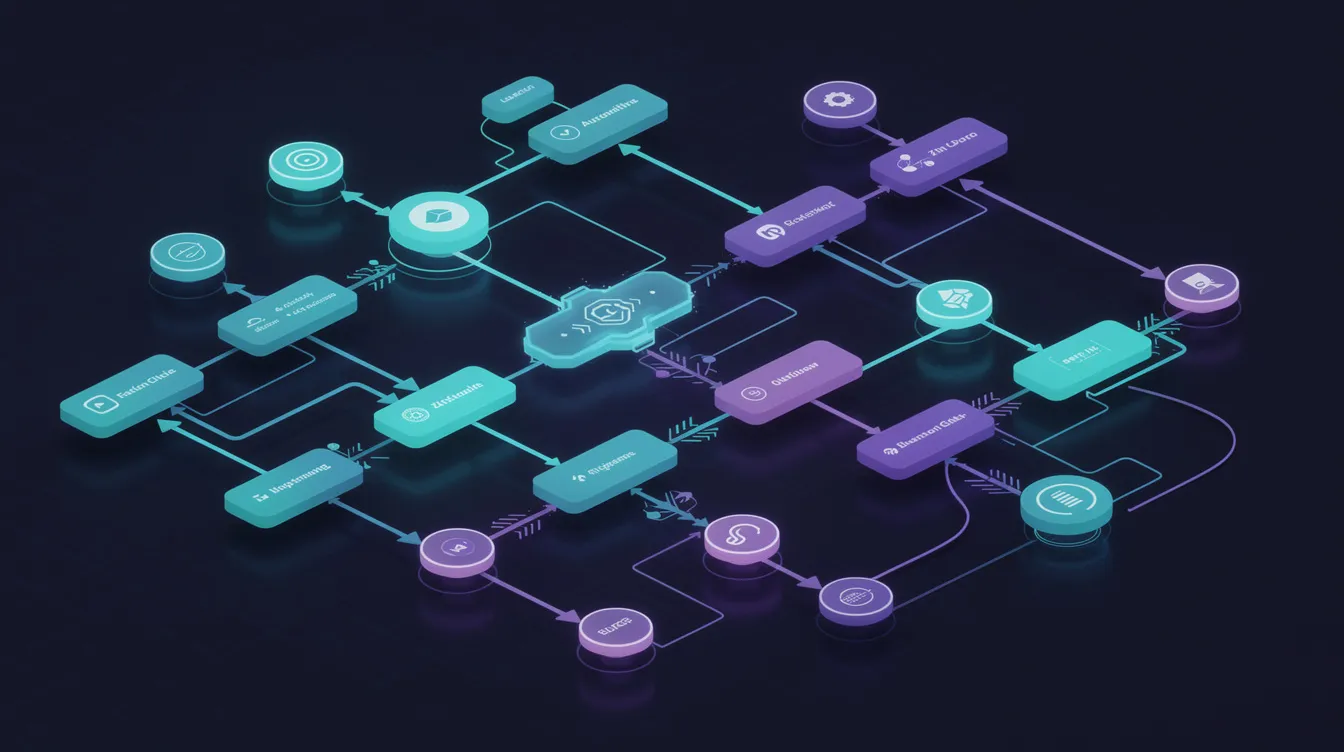
LangGraph is a framework built on top of LangChain for developing stateful workflows. In 2025–2026, it’s become the standard for multi agent systems, long-running processes, and agentic systems that require branching, loops, and persistent state.
Q: What is LangGraph and how does it relate to LangChain?
LangGraph models workflows as directed graphs. Nodes are Runnables, tools, or agents. Edges define transitions and carry state. Since LangChain 1.0, all agent execution happens on the LangGraph runtime.
Q: Why choose LangGraph over simple LCEL chains?
LCEL excels for linear, stateless pipelines. LangGraph handles backtracking, branching, human-in-the-loop workflows, and robust error handling across long-running processes. If your workflow needs loops or persistent state, LangGraph is the right choice for system design.
Q: Design a multi-agent system with LangGraph.
Assign roles: a Planner agent decomposes the task, a Researcher agent gathers data, and a Writer agent produces output. State flows between nodes, with conditional edges controlling which agent runs next. This pattern powers practical applications across domains.
Q: Design a digital marketing funnel optimizer.
Coordinate three agents: SEO Audit (crawls site, identifies issues), PPC Analysis (pulls ad data, calculates ROAS), and CRO Recommendation (suggests landing page improvements). Each node feeds findings into shared state; a final summarizer produces the client report.
Q: What are common pitfalls with multi-agent systems?
Runaway loops, cost explosions, coordination failures, and stale state. Always set termination conditions, monitor costs via dashboards, and implement guardrails. These scalability challenges are exactly what senior interviewers probe.
Integrating External APIs, Databases, and Business Systems
Enterprise interviews frequently test how candidates connect langchain applications to existing business systems. Knowing how langchain integrates with CRMs, analytics platforms, and internal APIs separates mid-level from senior candidates.
Q: How do you integrate external APIs?
LangChain integrates external APIs using RequestsWrapper or Tool modules. Wrap any REST endpoint as a Tool with a name, description, and input schema. Use async tools for non-blocking calls and secure credential management via environment variables.
Q: Best practices for using external apis safely inside agents?
Apply input validation on all tool inputs, enforce rate limiting and timeouts, handle non-JSON responses gracefully, and never expose sensitive data in tool descriptions or logs. Agents in LangChain can dynamically choose APIs to call, which makes security boundaries critical.
Q: How would you connect LangChain to a SQL database?
LangChain supports integration with REST APIs and SQL databases. Use SQLDatabaseToolkit and SQL agents for natural-language analytics. Always verify generated queries, implement read-only access where possible, and mitigate SQL injection through parameterized queries.
Q: Patterns for interacting with a marketing tech stack?
Design domain-specific custom tools for each provider-Google Ads, Meta Ads, HubSpot, GA4. Each tool handles authentication, pagination, and error formatting. The agent selects which tool to call based on the user query.
Q: How do you handle rate limits or API failures?
LangChain systems often handle errors through retries, fallbacks, and agent collaboration. Implement exponential backoff, caching layers for repeated queries, and circuit breakers for failing endpoints. Log all failures for post-mortem analysis.
At Codex Junction, we build business automation agents that orchestrate multiple SaaS tools-connecting contact forms to CRMs to email platforms-for small B2B clients, considering both legal considerations and data privacy.
Performance, Cost Optimization, and Production Deployment
Senior-level interviews probe understanding of latency, token cost, and reliability. If you can’t discuss improving performance and deployment architecture, you’ll stall at the system design round.
Q: How do you optimize LLM calls?
- Compress prompts to reduce token count
- Use smaller models where quality permits
- Caching results can improve LLM call performance for repeated queries
- Apply selective RAG (only retrieve when needed)
- Use batching and async execution for throughput
- Stream responses to reduce perceived high latency
Q: How do you benchmark LangChain applications?
Use LangSmith traces to visualize token cost per step, latency distributions, and error rates. Set up callbacks for llm calls tracking. Define evaluation metrics like answer relevance, faithfulness to ground truth, and latency percentiles.
Q: How would you deploy on AWS?
A concrete pattern: FastAPI application containerized on ECS or Lambda, API Gateway for routing, S3 for document storage, and a managed vector store (Pinecone, Qdrant, or RDS with pgvector). Use CI/CD pipelines with staging environments.
Q: Architecture for a high-traffic AI chatbot?
Autoscaling worker pools behind a load balancer, Redis for response caching and session state, queue-based processing for complex agent workflows, and pre-computed embeddings for common questions. This architecture serves thousands of marketing leads daily.
Q: How do you handle version control for models and prompts?
Pin model versions (e.g., gpt-4.1-2025-05-13), store prompt templates in version control, use LangSmith experiments for A/B testing, and maintain rollback capability if a prompt change causes hallucinations. This discipline is essential for mastering langchain in production.
Debugging, Observability, and LangSmith in Interviews
Complex chains and agents can silently fail-wrong tool called, malformed output, stale context. Interviewers want to see a systematic debugging mindset, not just “I’d check the logs.”
Q: What are callbacks in LangChain?
Callbacks allow logging of events in LangChain for monitoring. Use CallbackManager to capture on_llm_start, on_llm_end, on_chain_end, and on_tool_call events. Structure these into observability pipelines.
Q: How does set_debug help?
set_debug(True) logs detailed information about LangChain execution, showing every prompt, response, and intermediate step. Verbose=True prints execution steps for debugging in LangChain. Both should be disabled in production due to PII risks and performance overhead.
Q: What is LangSmith?
LangSmith is a debugging tool for LangChain applications. Utilizing observability tools like LangSmith helps debug and monitor ai applications through trace visualization, dataset-based evaluation, regression testing for prompts, and cost tracking dashboards. It’s become standard for serious LangChain development.
Q: How would you systematically debug low-quality outputs?
- Isolate the prompt-test it directly without RAG or tools
- Check memory for stale or irrelevant context
- Temporarily disable RAG to see baseline model quality
- Inspect intermediate steps via LangSmith traces
- Verify tool outputs for format and correctness
Q: How would you implement automated tests?
Use FakeLLM with mocked responses for unit tests, mock vector stores for retriever tests, and snapshot tests comparing agent outputs against expected baselines. Test corner cases: missing data, malformed schemas, API failures-this covers the interview scenarios interviewers love to probe.
Domain-Focused Scenario Questions (SEO, Marketing, and Automation)
Strong interviewers ask domain scenarios to see if you can apply LangChain to concrete business problems. At Codex Junction, we focus on SEO, eCommerce, lead generation, and business automation-these questions reflect real client work.
Q: Design a LangChain-based SEO assistant that audits a website.
Crawl the site using document loaders, build a RAG system over the content, score pages against SEO best practices (title tags, meta descriptions, heading structure, keyword density), and generate prioritized recommendations. Use output parsers for structured checklists. This is one of the most practical langchain applications for agencies.
Q: Design an ad budget reallocation recommender.
Pull Google Ads and Meta Ads data via external tools, calculate ROAS per campaign, and use an agent with multi step reasoning to recommend budget shifts. The agent reasons over external data and presents recommendations with supporting metrics-a clear example of how ai developers solve real problems.
Q: How could LangChain power a lead qualification chatbot?
Build conversational agents with multi-turn questions, vector-based FAQ lookup against external sources, and CRM integration. The chatbot qualifies leads based on budget, timeline, and service fit, then pushes qualified leads to HubSpot or Salesforce. Memory ensures the conversation doesn’t repeat questions.
Q: Build a content reviewer that checks brand tone and SEO.
Load the brand style guide into a vector store, create prompts that compare draft content against the guide, and use output parsers to generate pass/fail checklists. Integrate with Git for version control of content drafts.
Q: Build agents for form-to-CRM-to-email automation.
Design tools for each system: one reads form submissions, another creates CRM contacts, a third triggers email sequences. The agent orchestrates the flow, handling errors and retries. This kind of business automation is where mastering langchain delivers real ROI for more insights into client operations.

Advanced and Tricky LangChain Interview Questions
Senior or specialist roles involve deeper questions about edge cases, failure modes, and advanced topics that separate experienced practitioners from tutorial-followers.
Q: How would you handle 500-page policy PDFs in a RAG pipeline?
Apply hierarchical retrieval: split into sections, generate section summaries, then build summary-over-summary indices. Use map-reduce summarization chains for comprehensive coverage. This is where implementing document chunking aids in handling long inputs becomes non-negotiable.
Q: How do you reduce hallucinations?
Use strong retrieval to ground responses in relevant documents, implement answer-with-sources chains, validate tool outputs against expected schemas, and build refusal patterns for uncertain outputs. RAG reduces hallucination rates by 40-60% in production systems, making it the primary defense.
Q: How do you implement multi-step reasoning with verification?
Use ReAct patterns with tool output validation at each step. Decompose complex questions into sub-queries, verify each intermediate result, and aggregate only validated outputs. This structured input approach prevents compounding errors.
Q: Design feedback loops without retraining the base LLM?
Iterate on prompts based on logged failures, build rules engines for common edge cases, deploy human feedback dashboards for rating responses, and A/B test prompt versions via LangSmith. This creates continuous improvement without touching model weights-true reinforcement learning from human signals.
Q: How would you make a LangChain system auditable for regulated industries?
Schema-validated outputs, prompt and model version tracking, guardrails on tool inputs/outputs, human-in-the-loop review steps, access controls, and data privacy controls. Log every decision point for compliance. These are the interview scenarios that test whether you can operate in finance or healthcare.
How to Prepare for a LangChain Interview in 2–4 Weeks
Here’s a concrete study plan to turn this guide into interview-ready knowledge.
Week 1: Fundamentals and core components
- Build a simple Q&A chatbot using LCEL, a vector store, and memory
- Master all questions from the Core Fundamentals and Memory sections
- Get comfortable with prompt templates and output parsers through hands-on coding
Week 2: Agents, tools, and external knowledge
- Build at least one LangChain agent that calls an external API (try a public SEO or weather API)
- Experiment with react agents and tool-calling patterns
- Build a working rag pipeline with Chroma or FAISS locally
Week 3: Advanced workflows and deployment
- Learn LangGraph basics by building a two-node stateful workflow
- Set up observability with LangSmith on a test project
- Deploy a demo on AWS, GCP, or Render to understand production patterns
Mock interview practice:
- Pick 10–15 random questions from this guide and answer out loud
- Time yourself: 1–3 minutes per answer
- Record yourself and iterate on clarity, depth, and confidence
Adapt these patterns to your domain-whether finance, healthcare, or HR tech. Agencies like Codex Junction look for hands-on project repos as much as theoretical knowledge when evaluating ai developers and machine learning engineers.
Mastering these langchain interview questions prepares you to build serious langchain applications that power real business automation-not just demos. Whether you’re building SEO assistants, analytics agents, or complex workflows with multi agent systems, these patterns transfer directly to the production work that companies are hiring for in 2026.
Comments