
Modern smartphones and digital cameras capture high-quality images while using advanced image formats to save storage space. One such format is HEIF (High Efficiency Image Format). It is designed to provide excellent image quality with much smaller file sizes than traditional formats like JPG.
Although HEIF is an advanced image format, it is not supported by every website, software application, printer, or operating system. This is why many users need to convert HEIF to JPG, especially when uploading images online or sharing them with others.
JPG remains the world’s most widely accepted image format because it works almost everywhere. Whether you’re submitting online forms, creating a website, sharing photos, or preparing documents, JPG offers maximum compatibility.
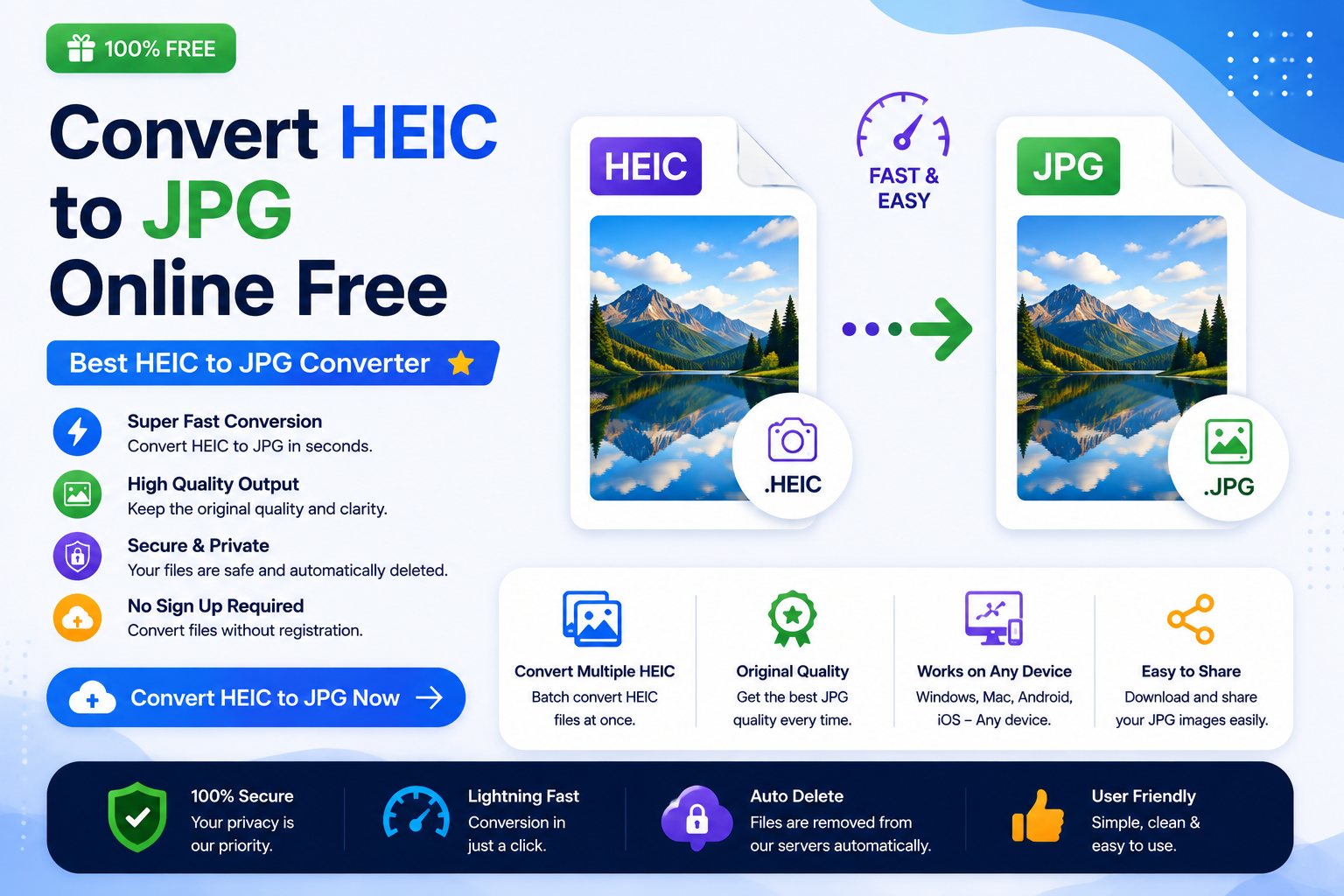
If you’re looking for a quick and free solution, use our online converter:
👉 https://codexjunction.com/apps/heif-to-jpg.html
This guide explains everything you need to know about HEIF, JPG, image conversion, compatibility, SEO, and optimization in simple language. It is suitable for beginners, students, freshers, developers, bloggers, digital marketers, photographers, and businesses.
What is a HEIF File?
HEIF stands for High Efficiency Image Format.
It is a modern image format developed by the Moving Picture Experts Group (MPEG) to improve image storage and quality.
HEIF is designed to:
- Reduce file size
- Improve image quality
- Store multiple images
- Support transparency
- Preserve editing information
- Support high dynamic range (HDR)
Unlike traditional image formats, HEIF uses advanced compression techniques that allow images to occupy much less storage while maintaining impressive visual quality.
HEIF vs HEIC – What’s the Difference?
Many beginners confuse HEIF and HEIC.
Although they are closely related, they are not exactly the same.
- HEIF is the image format standard.
- HEIC is one of the most common file extensions used for HEIF images, especially on Apple devices.
In simple terms:
- HEIF is the container format.
- HEIC is the file extension.
Both formats can usually be converted into JPG using the same conversion process.
What is JPG?
JPG (also written as JPEG) stands for Joint Photographic Experts Group, the organization that created the format.
JPG has been the industry standard for digital photography for decades because it provides:
- Excellent compatibility
- Good image quality
- Small file sizes
- Fast loading
- Easy sharing
Almost every operating system, browser, printer, and website supports JPG.
Why Convert HEIF to JPG?
Although HEIF offers better compression, it isn’t universally supported.
Converting HEIF to JPG helps solve compatibility issues.
Common reasons include:
- Uploading images to websites
- Sharing photos with friends
- Printing images
- Editing photos
- Submitting online applications
- Uploading passport photographs
- Creating PowerPoint presentations
- Publishing blog images
Use Our Free HEIF to JPG Converter
Need to convert HEIF images instantly?
Use our browser-based converter:
👉 https://codexjunction.com/apps/heif-to-jpg.html
Steps
- Upload your HEIF image.
- Click Convert.
- Download your JPG file.
No installation.
No registration.
Fast and secure.
Why Modern Devices Use HEIF
Smartphones today capture extremely detailed photographs.
HEIF helps reduce storage requirements while preserving excellent quality.
Advantages include:
- Smaller files
- Better image quality
- Higher color depth
- Multiple images in one file
- Improved editing support
This makes HEIF an excellent storage format.
Why JPG is Still Popular
Despite newer formats, JPG remains the most commonly used image format worldwide.
Reasons include:
- Universal compatibility
- Easy sharing
- Website support
- Printing compatibility
- Editing software support
- Broad browser compatibility
HEIF vs JPG
| Feature | HEIF | JPG |
|---|---|---|
| Compression | Excellent | Good |
| Image Quality | Excellent | Very Good |
| File Size | Smaller | Larger |
| Compatibility | Moderate | Excellent |
| Website Support | Limited | Universal |
| Printing | Moderate | Excellent |
| Editing Support | Moderate | Excellent |
When Should You Convert HEIF to JPG?
You should convert HEIF images when:
- A website only accepts JPG.
- Your computer cannot open HEIF.
- You need to print photographs.
- You’re submitting government forms.
- You’re sharing images via email.
- You’re creating educational materials.
- You’re uploading profile pictures.
How HEIF Compression Works
HEIF uses advanced image compression algorithms derived from modern video compression technology.
The format removes unnecessary image information while preserving:
- Colors
- Sharpness
- Dynamic range
- Fine details
This allows high-quality images to occupy much less storage.
How JPG Compression Works
JPG uses lossy compression.
Instead of preserving every pixel exactly, JPG intelligently removes information that is less noticeable to the human eye.
Benefits include:
- Smaller files
- Faster uploads
- Lower bandwidth usage
- Better website performance
Step-by-Step Guide
Converting HEIF images is very simple.
Step 1
Visit:
👉 https://codexjunction.com/apps/heif-to-jpg.html
Step 2
Upload your HEIF image.
Step 3
Click Convert.
Step 4
Wait a few seconds.
Step 5
Download your JPG file.
Done.
Benefits of Converting HEIF to JPG
The conversion offers several advantages.
Better Compatibility
JPG opens almost everywhere.
Easier Sharing
Email, WhatsApp, Telegram, and social media all support JPG.
Printing Support
Most printers work seamlessly with JPG images.
Website Uploads
Almost every website accepts JPG.
Editing
Nearly every image editing application supports JPG.
HEIF vs PNG
| Feature | HEIF | PNG |
|---|---|---|
| Compression | Better | Lossless |
| File Size | Smaller | Larger |
| Transparency | Limited | Yes |
| Photography | Excellent | Good |
HEIF vs WebP
| Feature | HEIF | WebP |
|---|---|---|
| Compression | Excellent | Excellent |
| Website Support | Limited | Excellent |
| Browser Compatibility | Moderate | Excellent |
JPG vs PNG
| Feature | JPG | PNG |
|---|---|---|
| Compression | Lossy | Lossless |
| File Size | Smaller | Larger |
| Transparency | No | Yes |
| Photography | Excellent | Moderate |
Common Uses of JPG
JPG images are commonly used for:
- Passport photos
- College applications
- Government recruitment
- Websites
- Blogs
- Product catalogs
- Marketing campaigns
- Email attachments
- Presentations
- Online learning
Does Converting Affect Image Quality?
Some quality reduction may occur because JPG uses lossy compression.
However, modern conversion tools preserve excellent image quality.
Most users cannot visually distinguish between the original HEIF image and a high-quality JPG version.
HEIF to JPG for Students
Students frequently convert images when submitting:
- Assignments
- Laboratory reports
- Scholarship applications
- College admission forms
- Online examinations
Many educational portals accept JPG instead of HEIF.
HEIF to JPG for Developers
Developers often convert HEIF images while:
- Testing file uploads
- Building websites
- Creating documentation
- Preparing UI assets
- Optimizing images
Since JPG works everywhere, development becomes easier.
HEIF to JPG for Businesses
Businesses convert HEIF files for:
- Product photography
- Employee ID cards
- Marketing campaigns
- Customer documentation
- Website uploads
JPG remains the preferred business image format.
Website Performance
Although HEIF images are smaller, browser support still varies.
JPG remains a practical choice for:
- Compatibility
- Reliability
- Universal uploads
For advanced website optimization, developers often convert optimized JPG images into WebP after editing.
Best Practices
Follow these recommendations.
- Keep original HEIF files.
- Compress large JPG images before uploading.
- Rename files descriptively.
- Add SEO-friendly alt text.
- Resize oversized images if necessary.
- Organize images into folders.
Common Mistakes Beginners Make
Avoid these mistakes:
Uploading HEIF images to unsupported websites.
Deleting original files immediately.
Using extremely large images online.
Ignoring image optimization.
Repeatedly converting the same JPG file.
Browser Compatibility
JPG images can be viewed directly in:
- Google Chrome
- Mozilla Firefox
- Microsoft Edge
- Safari
- Opera
No special software is required.
Is JPG Better Than HEIF?
It depends on your purpose.
Use HEIF when:
- Saving storage.
- Capturing photos.
- Working on Apple devices.
Use JPG when:
- Sharing images.
- Uploading websites.
- Printing.
- Editing.
- Creating presentations.
- Submitting online forms.
SEO Tips for JPG Images
To improve search visibility:
- Use descriptive filenames.
- Add meaningful alt text.
- Compress images before publishing.
- Avoid oversized dimensions.
- Enable lazy loading.
- Organize images logically.
Frequently Asked Questions (FAQs)
What is HEIF?
HEIF is a modern image format designed to provide excellent image quality with smaller file sizes.
Is HEIF the same as HEIC?
Not exactly.
HEIF is the format standard, while HEIC is one of its file extensions.
Why convert HEIF to JPG?
To improve compatibility with websites, applications, operating systems, and printers.
Can Windows open HEIF?
Some modern Windows systems support HEIF with additional codecs, but many users still prefer converting to JPG.
Will image quality decrease?
Some quality reduction may occur because JPG uses lossy compression, but the difference is usually minimal.
Is JPG supported everywhere?
Yes.
JPG is one of the most universally supported image formats.
Is this converter free?
Yes.
The CodexJunction HEIF to JPG Converter is completely free to use.
Related Tools on CodexJunction
If you frequently work with digital images, explore more free tools available on CodexJunction.
Image Conversion Tools
- HEIC to JPG Converter
- PNG to JPG Converter
- BMP to JPG Converter
- GIF to JPG Converter
- AVIF to JPG Converter
- WebP to JPG Converter
- Any File to JPG Converter
- Image to WebP Converter
- Image Compressor
- Image Resizer
PDF Tools
- Image to PDF Converter
- PDF to JPG Converter
- Merge PDF
- Split PDF
- Compress PDF
Learn Web Development
Improve your technical skills with beginner-friendly tutorials on CodexJunction:
- HTML Tutorials
- CSS Tutorials
- JavaScript Tutorials
- React.js Guides
- Frontend Development Roadmap
- Website Performance Optimization
- Technical SEO Tutorials
- Core Web Vitals Explained
- Image Optimization Best Practices
These learning resources help students, freshers, developers, bloggers, and professionals build modern, fast, SEO-friendly websites while understanding how optimized images improve user experience and search rankings.
Why Choose the CodexJunction HEIF to JPG Converter?
Our converter is designed for speed, simplicity, and reliability.
Features include:
- Free forever
- Browser-based conversion
- No software installation
- High-quality JPG output
- Fast processing
- Secure image conversion
- Mobile-friendly
- Desktop compatible
- Easy-to-use interface
Whether you’re converting smartphone images, preparing website assets, uploading official documents, or sharing memories with family and friends, our tool provides a fast and hassle-free solution.
Final Thoughts
HEIF is a modern image format that helps smartphones and digital cameras store high-quality photos while using significantly less storage space. However, because support for HEIF is still limited on some platforms, converting images into JPG remains the easiest way to ensure universal compatibility.
JPG continues to be the preferred format for websites, online applications, printing, editing, presentations, and everyday image sharing. It works seamlessly across operating systems, browsers, office software, and online platforms.
Whether you’re a student submitting assignments, a fresher uploading job applications, a web developer optimizing website assets, a blogger publishing content, or a business managing product photography, converting HEIF to JPG ensures your images are ready for almost every platform.
If you’re looking for a fast, secure, and beginner-friendly solution, the CodexJunction HEIF to JPG Converter is the perfect choice.
👉 Convert HEIF to JPG Online:
https://codexjunction.com/apps/heif-to-jpg.html
Start converting your HEIF images today and enjoy universally compatible JPG files that are ready for websites, online forms, presentations, social media, printing, documentation, and professional use.
Comments