
Introduction: What Are Embeddings and Why Do Interviewers Care?
If you’re preparing for an AI or data science interview in 2026, you’ll almost certainly face embeddings interview questions. Embeddings are numerical representations of text, users, products, or any other data, stored as dense vectors that capture semantic meaning. Instead of treating words as arbitrary labels, embeddings place them in a multi dimensional space where similar concepts sit close together.
This matters because embeddings power some of the most in-demand systems today: semantic search, retrieval augmented generation (RAG), recommendation engines, and intelligent chatbots. Since the LLM boom of 2023–2026, nearly every AI engineering role expects candidates to understand how embeddings work, how to evaluate them, and how to deploy them.
At Codex Junction, we work with embeddings across SEO search, content recommendation, and automation pipelines for client projects. We see firsthand how this technology transforms digital products.
This article gives you concrete interview questions, model answers, and simple explanations designed for freshers and junior engineers.
Key takeaways before you dive in:
- Embeddings are numeric vectors capturing meaning, not just keywords
- Embedding models are usually pre trained and sometimes fine-tuned
- Similarity metrics like cosine similarity and dot product matter
- Vector databases and indexing are essential in production
- Interviewers want you to discuss trade-offs, not just definitions
Core Concept: Explain the Concept of an Embedding Model
An embedding is a mapping from discrete input data (words, sentences, entire documents) into dense vectors in ℝⁿ that preserve semantic similarity. An embedding model converts text into these fixed-length vectors using a neural network encoder, often a transformer architecture.
Think of it this way: an embedding model converts text into a list of numbers. Texts with similar meaning produce similar vectors. “SEO expert” and “digital marketer” would yield vectors pointing in nearly the same direction, while “SEO expert” and “quantum physics” would point far apart.
The flow looks like this: raw text → tokenizer splits text into subword units → embedding model processes tokens → outputs a vector → you compute similarity with other vectors for search or recommendation.

Here are common interview questions on this topic:
- Q: What is an embedding model? A: A neural network that takes text and produces dense vectors such that semantically similar inputs have similar vectors in a shared vector space.
- Q: Give an example showing similarity in embedding space. A: “Sales pitch” and “marketing presentation” yield vectors close under cosine similarity because they share semantic relationships.
- Q: What similarity functions are common? A: Cosine similarity (measures angle between vectors), dot product (combines magnitude and direction), and sometimes Euclidean distance.
- Q: Can embedding models generate context-aware embeddings? A: Yes. Contextual models like BERT produce different embeddings for the same words depending on surrounding context, so “apple” in “fruit salad” differs from “Apple Inc.”
- Q: Why fine-tune embeddings? A: To adapt to domain-specific vocabulary and semantics (legal phrases, SEO terms, medical acronyms) so vector similarity aligns with domain-relevant meaning.
- Q: What is a tokenizer in this pipeline? A: A component that splits raw text into tokens or subword units before the embedding model encodes them into vectors.
Foundations: Dense vs Sparse, One-Hot vs Embeddings
Q: How do embeddings differ from one hot encoding?
One hot encoding represents each word as a vector of size |Vocabulary|, with a single 1 and all other positions set to 0. If your vocabulary has 50,000 words, each vector is 50,000-dimensional and almost entirely zeros. There’s no notion of similarity: “cat” and “kitten” are equally distant from each other as “cat” and “skyscraper.”
Dense vectors (vector embeddings) compress meaning into, say, 384 or 768 dimensions of continuous float values. Every dimension carries information, and word relationships are encoded naturally: similar words cluster together.
Dense vs sparse in retrieval:
- Sparse representations (TF-IDF, BM25) excel at keyword matching and exact term lookups. They’re fast, interpretable, and need no training data.
- Dense vectors capture semantic relevance, handling synonyms, paraphrases, and complex queries that keyword matching misses.
- Modern retrieval systems and rag systems often combine both through hybrid search: BM25 for recall on exact terms, embeddings for semantic understanding. This gives better search results than either approach alone.
Q: When would you rely on sparse features over embeddings? A: When you need exact terminology matching (brand names, legal definitions), when computational resources are limited, or when data availability is too small to justify dense model inference.
Types of Embeddings: Word, Sentence, Document & Multimodal
Embeddings come in several flavors, and interviewers like testing whether you know the differences.
- Word embeddings: Represent individual tokens. Classical models like Word2Vec and GloVe produce static word embeddings where each word has one fixed vector regardless of context. These capture basic word relationships but miss polysemy.
- Contextual word embeddings: Models like BERT and RoBERTa generate vectors that depend on surrounding context, so the same words produce different embeddings in different sentences.
- Sentence embeddings: Models like Sentence-BERT, Instructor, and OpenAI’s text-embedding APIs encode an entire sentence or paragraph into a single vector. These are the workhorses of semantic search and retrieval systems.
- Document embeddings: For encoding entire documents, often achieved through chunking strategies combined with sentence-level models.
- Multimodal embeddings: Models like CLIP align text and images into a shared embedding space, enabling cross-modal search (search text, retrieve images). Useful for ad creative matching, visual recommendations, and product catalogs.
Interview Q&A:
- Q: What is the difference between word embeddings and sentence embeddings? A: Word embeddings encode single tokens; sentence embeddings encode the aggregated meaning of full sentences, capturing word order and context.
- Q: When would document embeddings be needed? A: For long-form content like policy documents, blog archives, or knowledge bases in RAG pipelines where you need to retrieve relevant documents.
- Q: How might Codex Junction use these? A: Sentence and document embeddings power content clustering for SEO audits, internal site search, and related-article recommendations on client blogs.
Key Properties: Dimensionality, Context Window & Vocabulary
Three properties come up repeatedly in embeddings interview questions: dimensionality, context window, and vocabulary coverage.
Dimensionality refers to the number of values in each vector. Common sizes range from 128 to 1024, with some models like SGPT-5.8B producing 4096-dimensional embeddings. Higher vector dimensions capture richer nuance but demand more storage, increase latency during similarity search, and require greater computational resources. For most production use cases, 384 or 768 dimensions hit a practical sweet spot.
Context window is the maximum number of tokens the model can process in a single input. Modern 2025–2026 embedding models support 8K, 16K, or even 100K tokens. Despite large windows, chunking is still required for long texts because stuffing everything into one embedding can dilute the semantic signal. Overlapping chunks help preserve context at boundaries.
Vocabulary and tokenization determine how text data is broken into processable units. Subword tokenization lets models handle rare words, brand names, and technical SEO terms without an enormous vocabulary.
Interview Q&A:
- Q: How does dimensionality affect a model’s performance? A: Higher dimensions improve representational capacity but increase cost and risk overfitting with limited training data.
- Q: Why does context window matter in real RAG systems? A: Documents longer than the window must be chunked. Poor chunking loses context, degrading document retrieval quality.
- Q: What happens with rare vocabulary in embedding models? A: Subword tokenization handles it gracefully, splitting unknown terms into known sub-units.
Tokenization & Subword Units in Embedding Models
Q: What is tokenization and how does it affect embeddings?
Tokenization is the process of splitting raw text into smaller units (tokens) before feeding them into the model. There are three main approaches:
- Word-level: Each word is a token. Simple, but vocabulary explodes and rare words get unknown tokens.
- Character-level: Each character is a token. Tiny vocabulary, but sequences become very long and lose semantic density.
- Subword tokenization (BPE, WordPiece, SentencePiece): Splits text into frequent subword chunks. “searchengineoptimization” might split into “search,” “engine,” “optimization.” This balances vocabulary size with coverage.
Modern embedding models (BERT, RoBERTa, LLaMA-based encoders) use subword tokenization because it keeps vocabularies manageable, handles typos and new terms, and supports multilingual content. This directly affects how many tokens fit within a context window and how much API calls cost (since many services bill per token).
Q: Why is subword tokenization preferred in modern embedding models? A: It reduces vocabulary size while capturing rare or novel terms, improving robustness across domains and languages.
Q: What happens if tokenization splits domain jargon poorly? A: The semantic signal gets fragmented. The model may misinterpret specialized terminology, hurting retrieval quality. Fine tuning on domain text can mitigate this.
How Embedding Models Are Trained: From Word2Vec to Contrastive Learning
Understanding how embedding models learn helps you answer deeper interview questions about capturing semantic relationships in text data.
Classical methods:
- Word2Vec (Skip-gram, CBOW): Predicts context words from a target word (or vice versa). Words appearing in similar contexts end up with similar vectors. Introduced the idea that vector arithmetic captures word relationships (e.g., “king” − “man” + “woman” ≈ “queen”).
- GloVe: Factorizes a global word co-occurrence matrix from a corpus, producing static embeddings that reflect statistical patterns.
Modern contrastive learning:
Today’s sentence and document embedding models use contrastive objectives: pull embeddings of positive pairs (semantically similar) together, push negatives apart. Common loss functions include InfoNCE and Multiple Negative Ranking Loss. Hard negatives (documents that look similar but aren’t relevant) sharpen the model’s ability to distinguish subtle differences.
Architecture: two-tower (bi-encoder) models
A two-tower model uses separate encoders for queries and documents sharing the same embedding space. Document embeddings can be precomputed and stored offline, making nearest neighbor search fast at query time. This architecture powers most large scale datasets retrieval pipelines.
Interview Q&A:
- Q: Explain contrastive learning in embedding models. A: A training approach that pulls positive-pair embeddings closer and pushes negative-pair embeddings apart using losses like InfoNCE.
- Q: What is a two-tower model? A: Dual encoders (one for query, one for document) that map inputs into a shared space, enabling precomputed similarity search.
- Q: What are the trade-offs between bi-encoder and cross-encoder? A: Bi-encoders are fast and scalable; cross-encoders concatenate both inputs for full attention, yielding higher accuracy but much slower inference.
- Q: Why start from a pre trained foundation model? A: Training from scratch is compute-expensive and data-hungry. Pre trained models already encode broad language understanding from large corpora.
Pre-Trained vs Fine-Tuned Embedding Models in Practice
Pre trained models are general-purpose encoders trained on broad web data (Wikipedia, Common Crawl). Fine-tuned models are adapted to a specific task or domain using supervised examples or domain-specific corpora.
Examples: A team might start with an open-source model like sentence-transformers/all-MiniLM-L6-v2 for prototyping, then fine-tune it on a law firm’s knowledge base or an e-commerce product catalog. For API-based workflows, OpenAI’s embedding endpoints offer convenience but come with per-call costs and data privacy considerations. Self-hosted open-source models (Mistral-based, LLaMA-based encoders) provide full control and potentially lower cost at scale, but require infrastructure management.
Interview Q&A:
- Q: When would you fine-tune an embedding model? A: When your domain has specialized terminology, when the general model retrieves irrelevant neighbors, or when compliance requires owning the model and data.
- Q: What are the trade-offs between pre trained and fine-tuned embeddings? A: Pre trained models are cheaper and faster to deploy; fine-tuned models yield better domain performance but need more training data and maintenance.
- Q: API-based vs self-hosted-what’s the difference? A: APIs are easier to integrate but cost per call, add latency, and may raise privacy concerns. Self-hosted gives control and predictable costs at scale.
- Q: How does fine tuning reduce hallucinations in RAG? A: Better-aligned embeddings retrieve more relevant documents, so the generative model receives higher-quality context and produces fewer fabricated answers.
At Codex Junction, we choose between hosted and self-hosted embeddings based on each client’s compliance requirements, budget, and data sensitivity.
Embeddings in Retrieval-Augmented Generation (RAG) Systems
Q: What is Retrieval Augmented Generation and what role do embeddings play?
RAG combines a retrieval step with a generative model. Instead of relying solely on the language models’ memorized knowledge, RAG fetches relevant documents from an external source and feeds them as context into a large language model. Embeddings are the mechanism that makes retrieval work.

The typical RAG pipeline:
- Ingest documents (PDFs, web pages, knowledge base articles)
- Chunk long texts into manageable segments with overlap
- Embed each chunk using an embedding model
- Store embeddings in a vector database with metadata
- At query time, embed the user query with the same model
- Retrieve top-K similar chunks via similarity search
- Feed retrieved chunks as context into the LLM for generation
High quality embeddings reduce hallucinations because the LLM grounds its answers in actual retrieved content rather than guessing. Poor embeddings pull in irrelevant context, which degrades answer quality.
Interview Q&A:
- Q: How do you chunk documents for RAG? A: Split by token limit or semantic boundaries (paragraphs, headings) with overlap so edge context isn’t lost.
- Q: How do you ensure retrieved embeddings are high-quality? A: Use domain-specific fine tuning, evaluate recall@k, ensure query and document pipelines use the same model version and tokenization.
- Q: How would you mitigate hallucination in rag systems? A: Maximize retrieval recall, use rerankers (cross-encoders), validate context relevance before generation, and limit the LLM’s freedom to deviate from sources.
- Q: Give a real-world RAG example. A: An enterprise chatbot searching policy documents, an SEO content assistant retrieving similar documents from a blog library, or a developer support bot over API docs.
Vector Databases, Similarity Search & Locality Sensitive Hashing
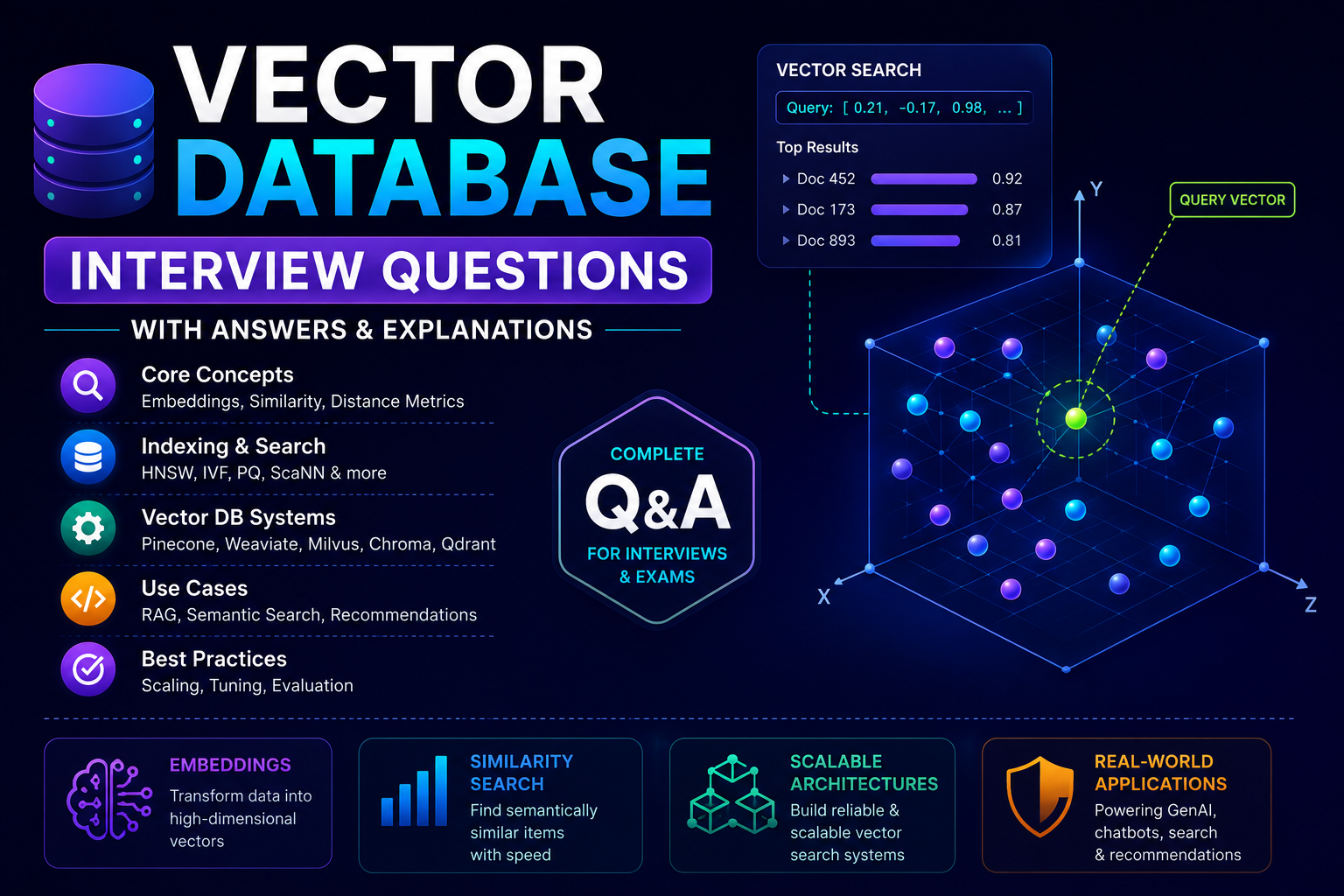
A vector database is a specialized system for storing high dimensional vectors and running fast similarity search over them. Unlike a relational database that handles structured rows and SQL queries, vector databases are optimized for nearest neighbor search across millions or billions of data points in high-dimensional space.
Core operations: insert embeddings with metadata, run k-nearest neighbor queries, filter results by metadata, and support hybrid search (combining vector similarity with keyword filters).
Common indexing techniques:
| Technique | How It Works | Best For |
|---|---|---|
| HNSW (hierarchical navigable small world) | Graph-based, layered navigation | High recall, low latency, mid-to-large datasets |
| IVF + PQ | Cluster vectors (IVF), compress with product quantization | Memory-constrained environments, very large scale datasets |
| Locality sensitive hashing | Hash similar vectors into the same bucket | Fast candidate filtering, grouping similar vectors |
| Brute-force | Compare query against every vector | Small datasets, accuracy baselines |
To illustrate the difference: searching 10 million vectors of 1024 dimensions with brute force might take ~500ms. Using an HNSW index can reduce that to ~1ms, trading a tiny amount of recall for dramatic speed gains. This is the core idea behind approximate nearest neighbor search.
Interview Q&A:
- Q: How is a vector database different from a relational database? A: Relational DBs store structured data with SQL; vector databases store high dimensional vectors and support approximate nearest neighbor queries with distance metrics.
- Q: What is LSH and when would you use it? A: Locality sensitive hashing maps similar vectors into the same hash bucket, reducing search candidates. Useful for fast pre-filtering in search systems.
- Q: Why use ANN instead of brute-force search? A: Brute-force is too slow at scale. ANN methods like HNSW provide near-exact results orders of magnitude faster, enabling real-time search results.
Common Distance Metrics: Cosine, Dot Product & Euclidean
Three distance metrics dominate embeddings work, and interviewers expect you to explain when each applies.
Cosine similarity measures the angle between two vectors, ignoring magnitude. Values range from −1 (opposite) to 1 (identical direction). It’s the most popular metric for text embeddings because it focuses on semantic direction rather than vector length.
Dot product multiplies corresponding elements and sums them. When vectors are normalized (unit length), dot product equals cosine similarity. Some libraries default to dot product for computational efficiency.
Euclidean distance measures straight-line distance between two data points in vector space. Less common for text embeddings because it’s sensitive to magnitude, but useful when absolute positioning matters (e.g., certain clustering tasks or dimensionality reduction scenarios).
Interview Q&A:
- Q: Why is cosine similarity commonly used for text embeddings? A: It captures directional similarity (semantic relevance) regardless of vector magnitude, which is what matters for comparing meaning.
- Q: When might Euclidean distance be acceptable? A: When vectors are normalized, or for tasks like clustering where absolute distance between data points matters. Also used alongside dimensionality reduction techniques like principal component analysis for visualization.
- Q: What are similarity measures vs similarity metrics? A: Similarity measures quantify how alike two vectors are (cosine, dot product); distance metrics quantify how far apart (Euclidean). They’re often inverses of each other.
Using Embeddings in Real Systems: Search, Recommendations & SEO
Embeddings aren’t academic curiosities. They power production search engines, recommendation systems, and content platforms used by millions.
Semantic search: Instead of relying on keyword matching alone, an embedding-based search system encodes the user query and all indexed content into the same embedding space, then retrieves semantically similar results. This handles paraphrases, synonyms, and complex queries that traditional search misses.
A typical retrieval architecture:
- Offline: Compute embeddings for all content, store in ANN index
- Online: Embed incoming user query, run vector similarity against index, return top-K candidates
- Optional reranking: Use a cross-encoder to reorder top candidates for higher precision
Interview Q&A:
- Q: Describe a pipeline that uses embeddings for semantic search. A: Precompute document embeddings, index in a vector database, embed user queries at runtime, retrieve top-K via ANN, optionally rerank with a cross-encoder for the final search results.
- Q: How would you use embeddings to improve a client’s website conversions? A: Replace or augment keyword-based FAQ/site search with semantic search. Users find relevant documents faster, reducing bounce rates and improving engagement.
- Q: How do recommendation systems use embeddings? A: Encode users and items (products, articles) as vectors. Recommend items whose embeddings are close to the user’s embedding based on browsing history.
At Codex Junction, we’ve used this approach to build related-article widgets, audience clustering for marketing funnels, and semantic blog discovery that surfaces content users actually want rather than what they literally typed.

Performance, Latency & Computational Resources
In production, embedding quality must be balanced against speed and cost. Large language models repurposed as embedding models can produce high quality embeddings, but they’re heavy. Smaller, efficient models like all-MiniLM-L6-v2 are faster and cheaper for large-scale retrieval.
Key optimizations:
- Batch processing: Embed many documents at once rather than one-by-one. GPU batch processing dramatically improves throughput.
- Model quantization: Reducing model precision (e.g., 8-bit integers) shrinks memory footprint and speeds inference with minimal quality loss.
- Caching mechanisms: Cache embeddings for frequently queried content or repeat user queries. Avoid recomputing what hasn’t changed.
- ANN indices: Pre-built indices (HNSW, IVF+PQ) ensure sub-millisecond search even over millions of vectors.
- Hardware selection: GPUs for embedding generation; optimized CPU or even edge hardware for serving the ANN index.
Interview Q&A:
- Q: How do you balance embedding quality vs cost? A: Start with efficient models for broad retrieval, use heavier models only where precision matters (e.g., reranking). Monitor recall@k and latency together.
- Q: How would you design a low-latency embedding service? A: Use batch processing for offline indexing, cache frequent queries, serve via ANN index, select a model size that fits your latency budget.
- Q: What constraints do SMEs face? A: Limited cloud budget and need for predictable costs. We’d recommend smaller open-source models self-hosted on modest GPU instances, with caching mechanisms to minimize redundant compute.
- Q: Why not always use the largest embedding model? A: Diminishing returns on quality, but linearly increasing cost and latency. For most retrieval tasks, computational efficiency matters more than squeezing out marginal accuracy.
Evaluating Embedding Quality: Benchmarks & Task-Based Metrics
Knowing how to evaluate embeddings is just as important as knowing how they work.
Intrinsic vs extrinsic evaluation: Intrinsic evaluation tests embedding quality directly (semantic textual similarity correlations, clustering quality). Extrinsic evaluation measures a model’s performance on downstream tasks like document retrieval accuracy, classification, or RAG answer quality. Interviewers value candidates who understand both.
Benchmarks: The MTEB (Massive Text Embedding Benchmark) covers 8 task categories, 58 datasets, and 112 languages. It evaluates models on retrieval, clustering, classification, and semantic similarity. A key finding: no single model dominates across all tasks, so model selection depends on your specific task.
The newer MMTEB benchmark (2025) expands coverage to 500+ tasks across 250+ languages, including code retrieval and long-document tasks.
Common metrics:
- Recall@k: How many relevant items appear in the top-k results
- nDCG: Weights higher-ranked results more heavily
- MRR (Mean Reciprocal Rank): Average reciprocal rank of the first relevant result
Interview Q&A:
- Q: How would you evaluate whether an embedding model is good for your use case? A: Run recall@k on a held-out set of queries, manually inspect nearest neighbors, measure latency, and compare against task-specific benchmarks.
- Q: What is MTEB and why might it matter? A: A comprehensive benchmark suite that compares embedding models across diverse tasks, helping you choose the right model for your specific task.
- Q: What is extrinsic evaluation for embeddings? A: Measuring how well embeddings perform in a real downstream application (search quality, RAG answer accuracy) rather than in isolation.
Typical Embeddings Interview Questions (With Model Answers)
Here’s a curated list of common embeddings interview questions for freshers and junior engineers. Treat this as a crib sheet for the night before.
- Explain the concept of an embedding in simple terms. An embedding is a vector representation that captures the semantic understanding of input data. Similar concepts produce similar vectors in a shared vector space.
- How are embeddings used in RAG systems? Embeddings encode both documents and user queries into dense vectors. The system retrieves the closest document chunks via similarity search and feeds them to a generative model as context.
- What is the difference between a bi-encoder and a cross-encoder? A bi-encoder produces separate embeddings for query and document, enabling fast retrieval. A cross-encoder processes both together with full attention, yielding higher accuracy but much higher latency.
- Name three vector databases. FAISS (by Meta), Pinecone (managed service), Milvus (open-source), Chroma (lightweight, popular for prototyping), and Weaviate.
- What is dimensionality reduction and why might you use it? Techniques like principal component analysis reduce vector dimensions to lower storage costs, improve speed, and enable visualization, while retaining most semantic information.
- How does fine tuning improve embedding quality? Fine tuning adapts pre trained models to domain-specific training data, aligning vector representations with domain semantics for better retrieval of similar documents.
- What are similarity metrics used with embeddings? Cosine similarity (direction), dot product (direction + magnitude), and Euclidean distance (absolute distance) are the three primary similarity measures.
- Why can’t you just use keyword matching instead of embeddings? Keyword matching fails on synonyms, paraphrases, and semantically similar content phrased differently. Embeddings capture semantic meaning beyond exact word overlap.
- What is approximate nearest neighbor search? A family of algorithms (HNSW, IVF, LSH) that find near-exact nearest neighbors much faster than brute-force, enabling real-time search over large scale datasets.
- How do you handle long documents that exceed the model’s context window? Chunk documents into smaller segments (with overlap), embed each chunk separately, and store all chunks in the vector database. At query time, retrieve the most relevant chunks.
- What’s the difference between static word embeddings and contextual word embeddings? Static embeddings (Word2Vec, GloVe) give each word one fixed vector. Contextual embeddings (BERT) produce different vectors depending on surrounding context.
- How would you monitor embedding quality in production? Track retrieval metrics (recall@k, MRR), monitor drift in embedding distributions over time, sample and manually review nearest neighbors periodically.
Scenario-Based Questions: Designing an Embedding-Powered Feature
Interviewers increasingly ask scenario questions to test whether you can apply embedding knowledge to real systems. Here are common scenarios with structured answers.
Scenario 1: “Design a semantic search feature for a company’s internal documentation.”
- Data ingestion: Collect all internal docs (Confluence, Google Docs, PDFs). Parse and clean text.
- Chunking: Split into 256–512 token chunks with 50-token overlap.
- Embedding model: Start with a pre trained model like all-mpnet-base-v2. Fine-tune if domain jargon is heavy.
- Vector index: Store in a vector database (e.g., Milvus or Chroma) with HNSW indexing.
- Integration: Build an API that embeds the user query, runs approximate nearest neighbor search, returns top-5 chunks with source links.
- Monitoring: Track click-through on results, collect feedback, measure recall@10 weekly.
Scenario 2: “Add embeddings to an existing keyword-based search on an e-commerce site.”
- Keep the existing BM25 layer for keyword matching.
- Add a dense embedding layer using a product-description embedding model.
- Combine scores (hybrid search) with tunable weights.
- A/B test against pure keyword search to measure conversion lift.
Scenario 3 (Codex Junction-specific): “Enhance SEO-driven blog discovery using embeddings and RAG.”
- Embed all blog posts at the paragraph level.
- When a visitor searches or a content strategist queries “how to improve page speed,” retrieve semantically similar blog sections, not just posts with those exact keywords.
- Feed retrieved sections into an LLM to generate a summary answer with links to source posts.
- This improves content discoverability, reduces bounce, and supports lead qualification.
When answering scenario questions as a fresher, focus on communicating trade-offs (cost vs accuracy, latency vs quality) clearly, even if you haven’t built these systems yourself. Interviewers value structured thinking over production war stories.
Beginner-Friendly Roadmap: How to Learn Embeddings for Interviews
If you’re starting from zero, here’s a practical learning path:
Step 1: Math foundations Understand vectors, dot products, cosine similarity, and basic linear algebra. You don’t need to prove theorems, just build intuition for why direction matters in vector space.
Step 2: Natural language processing basics Learn tokenization, bag-of-words, TF-IDF. Understand why these sparse approaches have limitations that embeddings solve.
Step 3: Classical embedding models Study Word2Vec and GloVe. Implement a simple Word2Vec from scratch or use Gensim. This builds intuition for how training data shapes word relationships.
Step 4: Modern embedding models Explore Sentence Transformers (official documentation is excellent). Experiment with models like all-MiniLM-L6-v2. Encode sentences and compute cosine similarity yourself.
Step 5: Vector databases and retrieval Try FAISS or Chroma locally. Build a small semantic search over your own notes or a collection of blog posts. This gives you a concrete project to discuss in interviews.
Step 6: RAG and production systems Build a simple Q&A bot over a PDF using embeddings + an LLM. This covers chunking, embedding, retrieval, and generation-the full pipeline interviewers care about.

Hands-on project ideas:
- Semantic search over your personal bookmarks or notes
- Cluster blog posts by topic using sentence embeddings
- Build a FAQ bot over a company’s documentation
- Compare retrieval quality across two different embedding models
Practicing with real data turns theoretical knowledge into experience-based answers that interviewers find convincing.
Conclusion: How to Talk About Embeddings Confidently in Interviews
Embeddings are no longer a niche ML concept. They’re a standard building block in modern digital products, from search to automation to content recommendation. At Codex Junction, we treat them as foundational infrastructure for everything from SEO-driven content discovery to intelligent client-facing tools.
The mental model you should internalize is simple: text → tokens → embeddings → similarity search → retrieved context → LLM answer. If you can walk an interviewer through this pipeline and explain the trade-offs at each step, you’re in strong shape.
Quick checklist of concepts to mention in your answers:
- Semantic similarity and how embeddings capture semantic meaning
- Retrieval systems and vector databases
- Fine tuning vs pre trained models
- Locality sensitive hashing and approximate nearest neighbor search
- Distance metrics (cosine similarity, dot product, Euclidean)
- Evaluation via recall@k, MTEB benchmarks, and extrinsic evaluation
- Production concerns: batch processing, caching mechanisms, computational efficiency
Combine theory with hands-on projects. Build something small, measure it, and be ready to explain what you learned. That combination of knowledge and practice is exactly what separates candidates who get offers from those who don’t.




Comments