
Introduction: Why Prompt Engineering Interview Questions Matter in 2026
Prompt engineering is the practice of designing inputs-instructions, context, and constraints-so that large language models and ai agents produce accurate and relevant outputs during inference. Since the generative ai boom that started in late 2022 with tools like ChatGPT, Claude, Gemini, and GitHub Copilot, this discipline has moved from curiosity to career requirement. By 2026, prompt engineering skills appear in job descriptions for AI Engineer, Full-Stack Engineer, Product Engineer, and Marketing Tech roles alike.
At Codex Junction, our B2B clients expect developers and marketers to use ai tools safely for content, UX copy, code generation, and automation. That means the hiring process now tests whether candidates can write prompts that are reliable, safe, and aligned with business goals-not just clever one-liners. Companies run prompt engineering interview rounds alongside coding and system design because prompt skills sit at the intersection of technical knowledge, product thinking, and responsible ai usage.
This article is your cheat sheet: a collection of engineering interview questions with model answers and clear explanations, aimed at freshers and early-career engineers. We cover everything from foundational concepts to advanced techniques like retrieval augmented generation and multi agent system design, written in simple technical English so you can walk into your next technical interviews with confidence.
Core Concepts: What Is Prompt Engineering? (With Entry-Level Q&A)
Prompt engineering is the practice of structuring instructions, context, and explicit constraints so that an ai system-whether an LLM, multimodal model, or ai agent-reliably produces the desired output. It operates entirely at inference time, meaning no model weights are changed.
Here are foundational interview questions every fresher should prepare:
- Q: What is prompt engineering? Prompt engineering is the process of designing input instructions-including context, roles, constraints, and examples-so that language models generate the desired outcome during inference. It involves understanding how models interpret natural language processing cues and controlling factors like tone, structure, and style to reduce hallucinations and increase relevance.
- Q: Why do we need prompt engineering if the model is already trained? The model is trained on broad objectives like next-token prediction, not your specific business task. Prompt engineering steers model behavior toward specialized results-like generating UX copy in your brand voice or producing structured data from unstructured text-without the cost and risk of retraining.
- Q: How is prompt engineering different from fine-tuning? When you fine tune a model, you update its weights using labeled data. Prompt engineering works only at inference: faster, cheaper, and safer since you avoid introducing unintended behavior through weight changes. Fine-tuning is better when you need deep adaptation on narrow tasks at scale.
- Q: Can you give a simple analogy? Think of prompt engineering like writing a detailed Jira ticket or API specification. The clearer your instructions, constraints, and examples, the fewer iterations and errors you get. Just as a spec defines roles, data formats, and edge cases, a good prompt should too.
Good prompt engineering improves factual accuracy, enforces safety through constraints, and boosts productivity by reducing the cycle of “bad prompt, tweak, rerun” across ai workflows like code generation, report drafting, and SEO content creation.
Types of Prompts and Roles in Modern AI Systems
Modern ai systems use layered message roles to control behavior. Understanding these roles and prompt categories is a common topic in any prompt engineering interview.

- Q: What are the different message roles in LLMs? System messages define global behavior and personality (e.g., “You are a concise, professional assistant that cites sources”). Developer messages carry hidden internal instructions. User messages contain the actual task. Together, these roles create the prompt structure that shapes every response.
- Q: Explain zero-shot vs few shot prompting with examples. Zero-shot prompting gives instructions without examples: “Classify this review as positive or negative.” Few shot prompting includes several input-output pairs first-say, three labeled reviews-then asks the model to classify a new one. Few-shot generally improves consistency for domain-specific or formatting-heavy tasks.
- Q: What is chain of thought prompting and how would you explain it to a non-technical stakeholder? Chain of thought prompting asks the model to show intermediate reasoning steps before reaching an answer. Think of it like solving a complex puzzle by writing down each step: “first I calculate X, then I check Y, then I conclude Z.” This approach helps with reasoning tasks, math, and multi-step logic.
- Q: How do prompt roles help in real applications? In a customer support chatbot, the system prompt enforces brand tone and compliance policies (“never share internal pricing formulas”). In internal ai assistance tools, developer messages embed tool-calling instructions. For classification tasks, few-shot examples in the user prompt guide the model toward consistent results. Controlling these roles is how you align model behavior with business requirements.
Interviewers often follow up by asking how prompt roles support brand tone alignment, safety, and compliance-so be ready to connect these concepts to real product scenarios.
Fundamental Prompt Engineering Interview Questions (With Model Answers)
This section collects must-know generic prompt engineering interview questions every fresher should prepare for. These appear in nearly every interview process that involves ai models.
How do you craft effective prompts for language models? To craft effective prompts, start by defining the role and context, then specify task instructions including input and output format, constraints, and examples if needed. Include boundaries like “in 200 words,” “no slang,” or “use formal brand voice.” Add few-shot examples when the domain is unusual. Finally, review outputs for factual accuracy, relevance, and style, then iterate. Effective prompts minimize hallucinations and produce accurate, relevant outputs aligned with both user needs and business goals.
What are the key components of a good prompt? A strong prompt includes: a clear task description, role definitions, context or background information, examples when helpful, output constraints (format, length, style), and safety instructions. Specifying structured output formats-like JSON, markdown tables, or bullet lists-ensures results are immediately usable. These components together drive model accuracy and reduce post-processing effort.
How do you refine a prompt that gives poor results? First, diagnose the issue: vagueness, hallucination, wrong tone, or format problems. Then iterate through prompt iteration: add more examples, tighten constraints, clarify roles, simplify ambiguous language, and test edge cases. Adjust temperature settings or try a different model. Collect human feedback and compare variants through A/B testing. This iterative testing mindset is what interviewers want to see.
What prompt engineering techniques are you familiar with? Key techniques include zero-shot, few-shot, chain of thought prompting, ReAct (reason-and-act) for ai agents, retrieval augmented generation for grounding, Tree-of-Thought for exploring multiple reasoning paths, structured prompting for consistent formatting, and self consistency prompting for validating answers across multiple generations. Each solves different problems: RAG handles outdated knowledge, CoT tackles complex reasoning, and structured prompting ensures deterministic outputs.
How do you evaluate the quality of a prompt? Evaluate prompt quality across factual accuracy, relevance, completeness, style adherence, and output format consistency. In production, track business metrics like user satisfaction, error rate, and task completion time. Use benchmark datasets to measure prompt performance over time, especially after model updates. Manual review combined with human evaluation keeps quality high.
When should you add examples vs. simplify language? Add examples when outputs are inconsistent or show wrong format. Simplify language when the prompt is too complex, causes model confusion, or approaches token limits. Balancing clarity against cost and precision is a practical skill interviewers value.
Scenario-Based Questions: Using LLMs for Code Generation & Debugging
Many engineering interview questions now test how you use generative ai for code generation, debugging, and optimization. Here are scenarios you should practice, along with what makes each prompt effective.
Scenario 1: Secure login API “Generate an Express.js login API with JWT authentication, rate-limiting per IP at 100 requests per minute, input validation, and unit tests using Jest. Use async/await, follow Airbnb style, return consistent JSON error messages.” This prompt works because it specifies language, framework, security requirements, performance constraints, coding style, and test expectations. A poorly designed prompt like “make a login API” would produce generic, insecure code.
Scenario 2: Debugging a memory leak “My React 18 SPA has a suspected memory leak in a component using useEffect without cleanup. Provide debugging steps using React DevTools and Chrome Profiler, identify common leak patterns, and suggest code fix examples.” Specifying version, environment, symptoms, and desired tools ensures the ai system returns targeted advice rather than generic suggestions.
Scenario 3: Language translation with constraints “Translate this Python data processing script into Go using goroutines for parallelism, proper error returns, unit tests, and idiomatic Go style.” Including performance constraints (concurrency), error handling conventions, and style expectations helps produce generated code that is actually usable.
Scenario 4: Legacy refactoring Refactoring legacy PHP to modern Laravel requires specifying the PHP version, Laravel version, patterns to replace, security concerns like SQL injection prevention, Eloquent ORM usage, and routing structure. Without these details, code snippets from the model would miss critical migration requirements.
Scenario 5: SQL optimization For optimizing SQL queries on a marketing analytics dashboard, specify the database engine (Postgres or MySQL), dataset size, bottleneck patterns, required indexes, and expected output aggregations.
Each scenario demonstrates that the final prompt must include domain, constraints, required output, technologies, and non-functional requirements. Interviewers score how methodically you build concise prompts that cover these dimensions.
Advanced Prompting Techniques (CoT, ToT, ReAct, RAG) in Interview Context
Advanced prompt engineering techniques frequently appear in mid-level engineering interview rounds, but freshers should recognize them and understand trade-offs.
- Chain of Thought (CoT): Typical question: “When would you use CoT?” CoT prompts force the model to break complex tasks into intermediate reasoning steps before answering. This improves performance on math word problems, multi-hop QA, and logic puzzles. Trade-off: more tokens, slower responses, and sometimes misleading reasoning steps if the prompt is unclear. CoT is one of the most well-studied prompt engineering techniques for complex reasoning.
- Tree of Thoughts (ToT): “How does ToT differ from CoT?” ToT explores multiple reasoning paths in parallel, evaluates them, and selects the best. Useful for creative problem-solving like brainstorming product features or planning routes. More compute-intensive than CoT but avoids getting stuck on a single poor reasoning path.
- ReAct (Reason + Act): “How does ReAct help tool-calling agents?” ReAct alternates between reasoning steps and actions-like calling an API, querying a database, or checking a rag system-then incorporates observations. This makes ai agents dynamic and grounded. Example: an agent that checks inventory via API before recommending products.
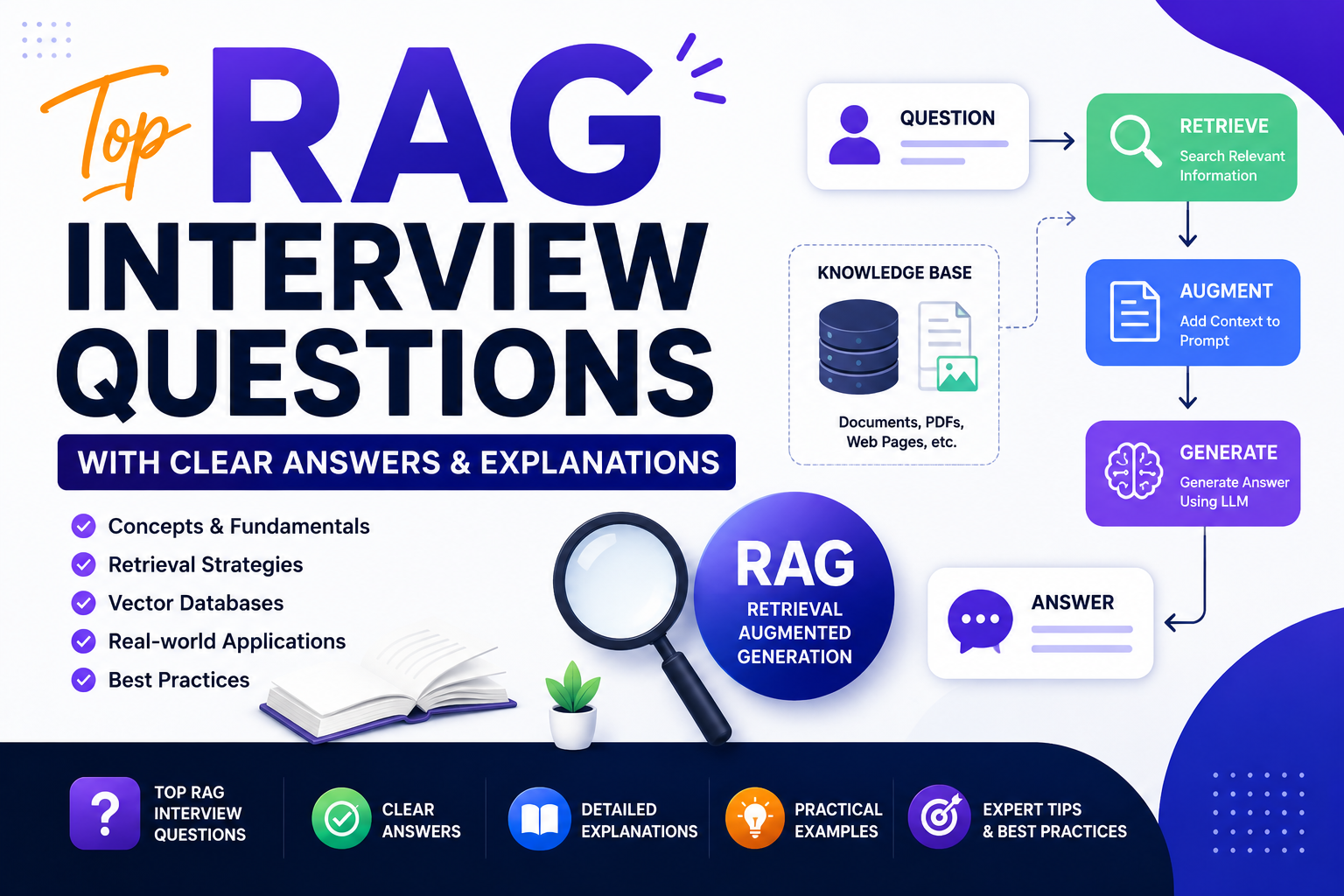
- Retrieval-Augmented Generation (RAG): “How does prompt design change with RAG?” RAG integrates external knowledge retrieval into generation. Your prompt must instruct the model to cite retrieved sources, restrict assertions to retrieved documents, and handle missing information gracefully. This dramatically improves factual accuracy for domain-specific FAQ, company policies, or recent events.
These techniques help reduce hallucinations and deepen reasoning-a common interview theme in 2026. Understanding when each applies separates prepared candidates from the rest.
Applied Prompt Engineering for Digital Products (UI/UX, Marketing, Automation)
Prompt engineering extends well beyond code. At Codex Junction, we apply it across UI/UX design, digital branding, SEO, performance marketing, and business automation-and interviewers increasingly test these applications.
- Q: How would you design prompts to generate UX copy for a fintech onboarding flow? Specify the target audience (first-time investors, age 25-40), brand voice (trustworthy, jargon-free), reading level (8th grade), screen context (mobile signup), and compliance constraints (no guaranteed returns language). Ask for three variants for A/B testing. This shows you understand prompt design for real products.
- Q: How would you use prompt engineering for SEO-optimized blog outlines? Include the primary keyword, desired structure (H2/H3 headings, meta description, CTAs), word count range, audience description, and brand tone. Use prompt templates that can be reused across campaigns, improving speed and consistency for B2B clients.
- Q: How can prompt engineering support marketing automation? For email sequences or ad variants, specify audience segment, funnel stage, CTA goal, character limits, and compliance rules. Request multiple options with different angles. Prompt chaining can connect audience research outputs to copy generation prompts for an end-to-end workflow.
- Concrete example: “Generate three Facebook ad variants for a local dental clinic targeting families within 10 miles. Tone: warm, reassuring. Each ad: headline under 40 characters, body under 125 characters, one CTA. Avoid medical claims. Output as a numbered list.” This kind of concise output specification shows interviewers you understand both prompt craft and business context.
Reusable prompt templates across campaigns save time and maintain brand consistency-a key value proposition when serving small to mid-sized businesses.
Evaluating Prompt Output: Accuracy, Safety, and Business Value
Good engineers don’t just write prompts-they evaluate AI responses against clear criteria. Interviewers test this skill to see if you can maintain quality in production ai systems.

- Q: How do you evaluate the quality of AI outputs? Assess across four dimensions: factual accuracy (cross-check against source documents or APIs), relevance and completeness (does it answer all parts?), style and formatting adherence (brand voice, structure), and business KPIs (CTR, conversion rate, task completion time, time saved). Prompt quality is only as good as the output it consistently produces.
- Q: How would you measure factual accuracy and reduce hallucinations? Use RAG to ground responses in verified documents. Cross-reference outputs against known data. Include instructions like “only use information from the provided context” and “say ‘I don’t know’ when uncertain.” Track hallucination rates over time using a benchmark dataset.
- Q: Which metrics would you track in production? For a customer support chatbot, track resolution rate, escalation rate, and user satisfaction scores. For content generation, measure edit distance (how much humans change the output), time saved, and SEO performance. Use confusion matrices for classification tasks.
- Concrete evaluation workflow: For classifying customer support emails into “billing,” “technical issue,” “sales,” and “other,” prepare 100 labeled emails as a benchmark. Run two prompt variants, compute accuracy and confusion matrix for each, manually inspect misclassifications, and select the winner. This is human evaluation combined with quantitative rigor.
Emphasize continuous learning in your answers: models evolve, user feedback reveals new failure modes, and prompt versioning ensures you can track what changed and why. Interviewers want to see this iterative mindset.
Common Mistakes in Prompt Engineering (And How to Fix Them in Interviews)
Many interview questions indirectly test whether you recognize and avoid common prompt engineering pitfalls. Making these mistakes is normal-knowing how to fix them is what matters.
- Too vague: “Write an article about marketing” has no audience, length, tone, or purpose. Fix: add target audience, structure (H1/H2), tone, word count, and function (blog vs. social post). Concise prompts with clear constraints always outperform sprawling, vague ones.
- Overloading with unrelated tasks: “Write product copy, SEO meta descriptions, ad slogans, and social posts in one prompt” mixes objectives and degrades quality. Fix: split into separate prompts or clearly section each task with distinct instructions.
- Missing output format: Without format specifications, the model produces free-form text that requires heavy editing. Fix: specify JSON, markdown table, bullet list, or whatever structured output your downstream process needs.
- Ignoring model limitations: Forgetting context length limits, knowledge cut-off dates, or domain gaps leads to frustration. Fix: use RAG for current information, chunk long inputs, and include fallback instructions.
- Skipping bias and safety checks: Prompts that unintentionally produce discriminatory or harmful content are a serious risk management failure. Fix: add safety instructions, test prompts with diverse inputs, and include human review.
- Accepting first output as production-ready: Interviewers watch for candidates who copy AI output without verification. Fix: always plan for revision, error checking, and human oversight.
Bad prompt: “Generate e-commerce product descriptions.” Improved prompt: “Generate three product descriptions for sock brand ‘Happy Feet,’ targeting women aged 25-35, playful brand voice, each 120-150 words, including care instructions, highlighting sustainable materials. Output as HTML with h2 for title, p for body.”
The improved version shows you understand how to design prompts that produce relevant outputs with minimal human correction.
Ethics, Bias, and Safety: Interview Questions You Can’t Skip
In 2026, nearly all serious AI engineering interviews include questions about ethical and safe use of language models. Even junior candidates can score well by demonstrating awareness and a responsible mindset.
- Q: How can you use prompt engineering to mitigate bias in AI outputs? Use inclusive examples in few-shot prompts. Avoid stereotypical language in instructions. Test prompts with inputs across demographics. Include explicit instructions like “use neutral, non-stereotypical language.” Implement human-in-the-loop review for sensitive applications. This reflects responsible ai practices.
- Q: What would you do if an AI model generated harmful content? Stop deployment. Analyze which prompt allowed it. Add explicit constraints and content filters to the system prompt. Escalate to the team. Test prompts against adversarial inputs before redeploying. Document the incident for risk management purposes.
- Q: How do you design safe prompts for healthcare, finance, or legal domains? Include explicit disclaimers: “This is for educational purposes only, not medical or legal advice. Consult a licensed professional.” Restrict the model from making diagnoses or guarantees. Require citing sources. Limit scope to general information only.
- Concrete case: For a medical FAQ chatbot, your system prompt should state: “You are a health information assistant. Never diagnose conditions. Always recommend consulting a licensed doctor. Only reference peer-reviewed sources. If unsure, say ‘I don’t have enough information to answer safely.'” This shows interviewers you prioritize factual accuracy and user safety over impressive-sounding outputs.
Human ingenuity remains essential-ai tools amplify our capabilities, but ethical judgment cannot be delegated to the model.
System Design & Multi-Agent Scenarios: Prompting Beyond Single Queries
Senior interviews sometimes ask how you would design a prompt-driven system, but freshers should know the basics of multi-step and multi agent system prompting.
- Q: How would you design prompts for a multi-agent AI system building a web app? Assign clear roles via system prompts: a Planner agent outlines deliverables, a Researcher agent gathers requirements and references, a Coder agent writes implementation. Each agent gets its own prompt with role definition, allowed tools, output format, and handoff instructions. Use intermediate artifacts-plans, checklists, partial code-to maintain alignment across agents. This is prompt chaining at the system level.
- Q: How does prompt design change when you use RAG? With a rag system, your prompt must instruct the model to use only retrieved documents for factual claims, cite sources explicitly, and handle missing information gracefully (“If the retrieved context doesn’t contain the answer, say so”). You also need retrieval prompts-queries that fetch the right documents from your vector database.
- Q: How do you handle long conversations exceeding the token limit? Use summarization prompts to compress earlier context into concise snapshots. Selectively archive less relevant exchanges. Store key facts in external memory (vector embeddings or structured data stores) and retrieve them as needed.
- Realistic example: An AI system helping Codex Junction build landing pages could use three agents: one designs wireframes based on client brief, another writes UX copy following brand guidelines, and a third analyzes SEO opportunities using retrieved competitor data. Each agent’s system prompt defines its role, constraints, and the desired output format. The orchestration layer chains outputs so the copy agent receives the wireframe agent’s structure before writing.
Practical Tips to Prepare for Prompt Engineering Interviews (For Freshers)
This section translates theory into a preparation checklist for students and engineers with zero to two years of experience.
Practice daily with at least one public LLM-ChatGPT, Claude, or Gemini-focusing on improving a single prompt multiple times rather than writing many one-off prompts. This builds the prompt iteration muscle interviewers look for. Keep a “prompt and output” notebook or Git repository to track what works and why, which also serves as a portfolio artifact.
Build one or two mini-projects: an AI-assisted coding helper, a content generator, or a simple customer support chatbot. Deploy them on GitHub or a free hosting platform. These demonstrate you can move from crafting prompts to building real ai workflows.
Try this exercise typical of interviews: take a vague prompt like “Write me some interview questions” and improve it to “Generate 10 behavioral interview questions for a mid-level React developer role, covering component design, state management, and testing. Format as a numbered list with one follow-up question each.” Practice explaining what you changed and why.
Prepare to discuss limitations of ai tools: knowledge cut-off dates, hallucination risks, privacy concerns, and when not to rely on artificial intelligence. Interviewers value candidates who know when a data analyst should verify outputs or when automatic prompt engineering tools might help optimize at scale.
Study resources like the TestMu AI prompt engineering guide for additional question patterns and stay current with the rapidly growing prompt engineering market.
How Codex Junction Uses Prompt Engineering in Real Client Projects
At Codex Junction, we use prompt engineering daily across web development, digital marketing, and automation projects for small to mid-sized service businesses. Here is how it works in practice.
UI copy generation for e-commerce redesign: For a 2025 e-commerce project, we built prompt templates specifying brand voice, product category, target audience, and page context (product detail, cart, checkout). The system prompt enforced tone and compliance; the user prompt contained product data. Designers reviewed and refined outputs, cutting copy creation time by roughly 60%.
Test case and documentation generation: For a custom CRM built on Laravel and React, we used LLMs to generate unit test skeletons and API documentation. Prompts included framework versions, coding conventions, and test patterns. Engineers validated generated code against the actual codebase-ai assistance accelerated documentation, but human oversight ensured accuracy.
SEO content workflows: For a B2B SaaS client, we generated topic clusters and first-draft briefs using prompts that specified keyword targets, audience personas, content structure, and competitive angle. Each brief went through editorial review before becoming a final prompt for full draft generation.
Internal analytics agents: We built an internal ai agent that summarizes marketing dashboard data and suggests performance optimizations. The agent’s system prompt defines its analyst role, the retrieval layer pulls fresh data, and the output follows a structured report template.
Key lessons: prompt versioning matters because model updates shift output quality. Style guides maintain brand consistency. Test prompts with edge cases before deploying to clients. And always keep humans in the loop for factual content-this connects directly to how you should answer scenario questions in your AI and ML interviews.
Sample Prompt Engineering Interview Round: Walkthrough and Evaluation
Picture a 30-45 minute interview round where you collaborate with an AI coding assistant live. Here is how it typically unfolds.

Task: “Build a simple REST API for a todo app with user authentication using an AI assistant.”
Step 1 – Initial prompt: The candidate writes something like: “Create a todo API with login.” This is intentionally minimal. The interviewer watches to see how quickly you recognize it needs improvement.
Step 2 – Critique and refine: You review the AI’s output, spot missing elements (no input validation, hard-coded secrets, no error handling, no tests), and write an improved prompt: “Generate a Node.js Express REST API for a todo app with JWT authentication, input validation using Joi, proper error handling returning JSON error messages, environment variables for secrets, and unit tests using Jest. Follow RESTful conventions and include API documentation comments.” This shows you can produce concise prompts with explicit constraints.
Step 3 – Feature addition: The interviewer asks you to add pagination. You write a targeted follow-up prompt specifying query parameters, default page size, and response format including total count and page metadata.
How interviewers score:
- Clarity and completeness of prompts
- Ability to spot AI mistakes (security gaps, missing edge cases)
- Security and performance considerations
- Communication skills-explaining your reasoning aloud
Tips for freshers: Think aloud throughout. State why you are adding each constraint. Mention how you would verify AI-generated code before production: run tests, check for hard-coded secrets, review dependencies, and validate against requirements. Interviewers value the verification mindset as much as the prompt itself. The goal is to demonstrate that you can design prompts that lead to a desired outcome while maintaining quality standards for production ai systems.
Conclusion and Next Steps for Continuous Learning
Prompt engineering is now an essential skills category tested alongside coding and system design in engineering interviews across the industry. Whether you are targeting AI Engineer, Full-Stack Developer, or Marketing Tech roles, your ability to write effective prompts, evaluate outputs, and understand ethical implications will directly impact your success in the interview process and beyond.
Even as a fresher, you can stand out by mastering core concepts-prompt types, chain of thought prompting, retrieval augmented generation-and practicing scenario-based prompt writing with real tools. Building small projects that showcase AI-assisted workflows gives you concrete stories to tell interviewers and demonstrates business awareness that goes beyond textbook answers.
Adopt a mindset of continuous learning. Models, best practices, and ai tools will keep evolving well beyond 2026, so staying current through documentation, community blogs, and hands-on experimentation is non-negotiable. At Codex Junction, we look for candidates who combine technical fundamentals, clear communication, and responsible AI usage to drive real business outcomes for our clients. The prompt engineering market will only grow as artificial intelligence integrates deeper into software engineering, digital marketing, and automation over the next several years. Start practicing today-your future interviews will thank you.
Quick FAQ: Prompt Engineering Interview Questions (2026 Edition)
Do I need to know advanced math or deep learning theory for prompt engineering interviews? Not usually. Most roles prioritize strong reasoning, clear communication, and practical prompt-writing ability over research-level math. Understanding how language models work at a high level (tokens, context windows, inference vs. training) is sufficient for most positions.
Which programming languages should I know to work with LLMs and ai agents? Python and JavaScript/TypeScript are the most common for scripting and calling LLM APIs. Familiarity with REST APIs, JSON, and at least one prompt SDK (OpenAI, Anthropic, or similar) gives you a strong foundation.
How can non-CS graduates prepare for prompt engineering roles? Focus on structured thinking: learn to break fuzzy business needs into clear, constrained prompts. Practice daily with public LLMs. Build a portfolio of before-and-after prompt improvements. Many successful prompt engineers come from linguistics, marketing, or domain-expert backgrounds.
Are prompt engineering skills still useful if models get smarter? Yes. Smarter models still need clear instructions for specialized tasks, brand alignment, safety, and structured data outputs. The skill evolves from “getting the model to work” to “orchestrating complex ai workflows efficiently.” Automatic prompt engineering and prompt chaining will augment human skills, not replace them.
What portfolios or projects impress hiring managers most? Projects that show end-to-end thinking: a working chatbot, a content generation pipeline with prompt versioning, or an ai agent that calls tools and handles errors. Include documentation showing your prompt design process, iterations, and evaluation results. Hiring managers value demonstrated judgment more than flashy demos.
How important is understanding ethics and safety? Critical. Nearly every serious interview includes questions about bias, hallucination, and responsible deployment. Candidates who proactively mention safety constraints, human oversight, and risk management consistently score higher-even without production experience.
Comments