
Introduction: Why Vector Database Interview Questions Matter in 2026
This article gives freshers and junior AI engineers a practical set of vector database interview questions with clear answers and explanations you can use right away. Vector databases are crucial for fast similarity searches in AI, and as LLMs, rag systems, and semantic search have become standard infrastructure in 2025–2026, interviewers now regularly test this knowledge in AI engineering, data engineering, and backend roles.
At Codex Junction, we’re a 360° digital and IT solutions agency, so we focus on implementation-ready knowledge-the kind you’d actually apply when building search, recommendation systems, or AI-powered chatbots for real clients. Questions below are grouped from basics to advanced topics like indexing strategies, similarity metrics, and hybrid search, so you can ramp up step by step.
Core Concepts: “What Is a Vector Database?” Starter Questions
These starter questions test whether you understand what vector databases are and why they matter. Expect these in nearly every interview.
Q1: What is a vector database? A vector database is a specialized database designed to store and query high dimensional vectors (embeddings) produced by machine learning models like BERT, OpenAI’s text-embedding-3-large, or CLIP. Unlike traditional databases that use tables and rows for structured data, vector databases excel in unstructured data handling and querying-they find similar vectors rather than performing exact matches or joins.
Q2: What is a vector embedding and why is it important? Vector embeddings are dense numerical representations of data types like text, images, or audio, capturing the semantic meaning of content. They facilitate natural language processing tasks through embeddings. For example, a BERT model produces a 768-dimensional sentence embedding for a support ticket. Vector embeddings typically have 128 to 3072 dimensions depending on the embedding model used.
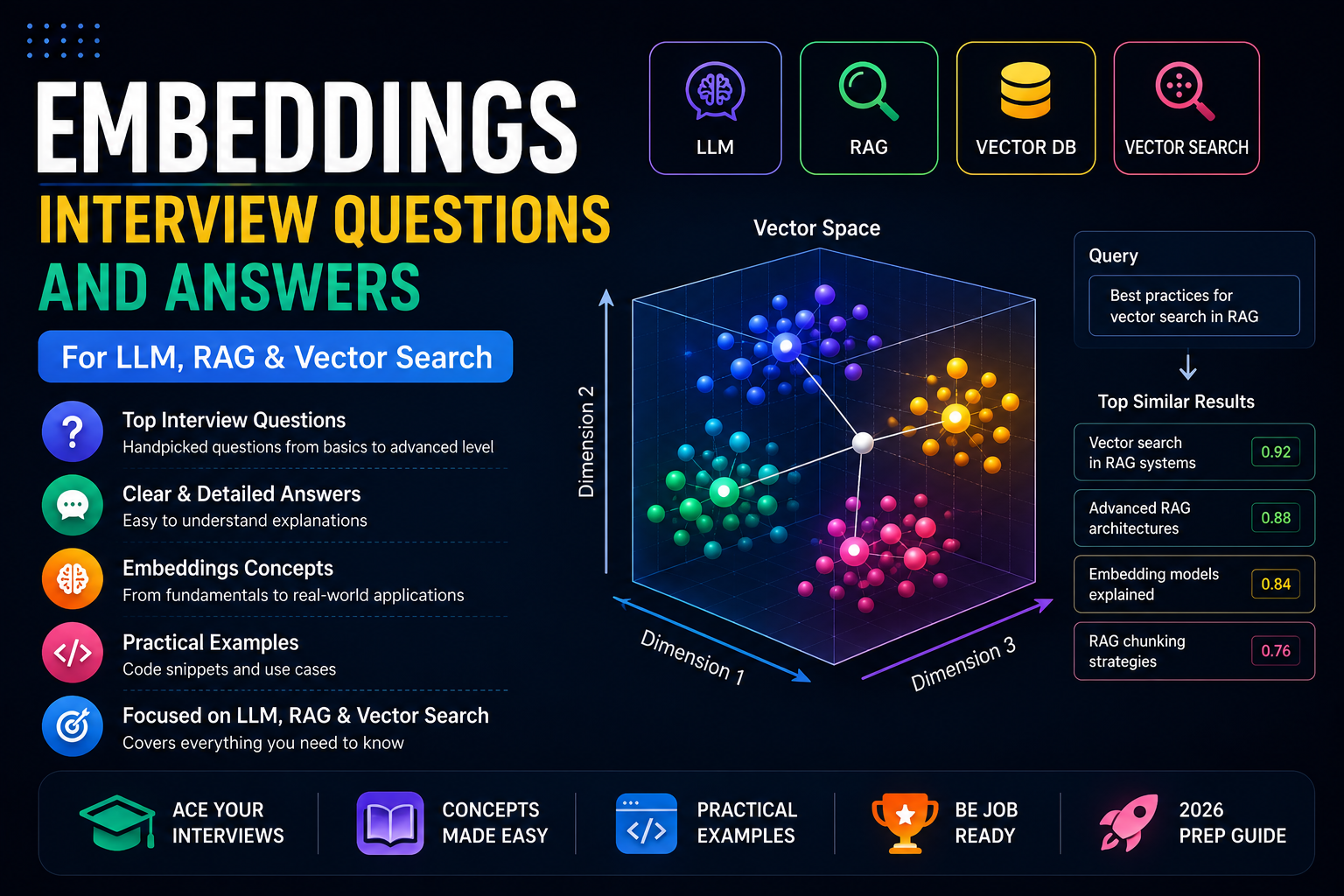
Q3: How does similarity search work in a vector database? When you submit a user query, the system converts it into a query vector, then computes distance metrics against stored vectors using measures like cosine similarity or euclidean distance. The database returns the top-k nearest neighbor results-vectors closest in the multi dimensional space.
Q4: How is a vector database used in a semantic search engine? Index FAQ article embeddings in the vector database. When a user asks a question, convert it to an embedding, perform top-k fast similarity search, then rank and return the best answers. Common use cases include recommendation systems and semantic search across knowledge bases.
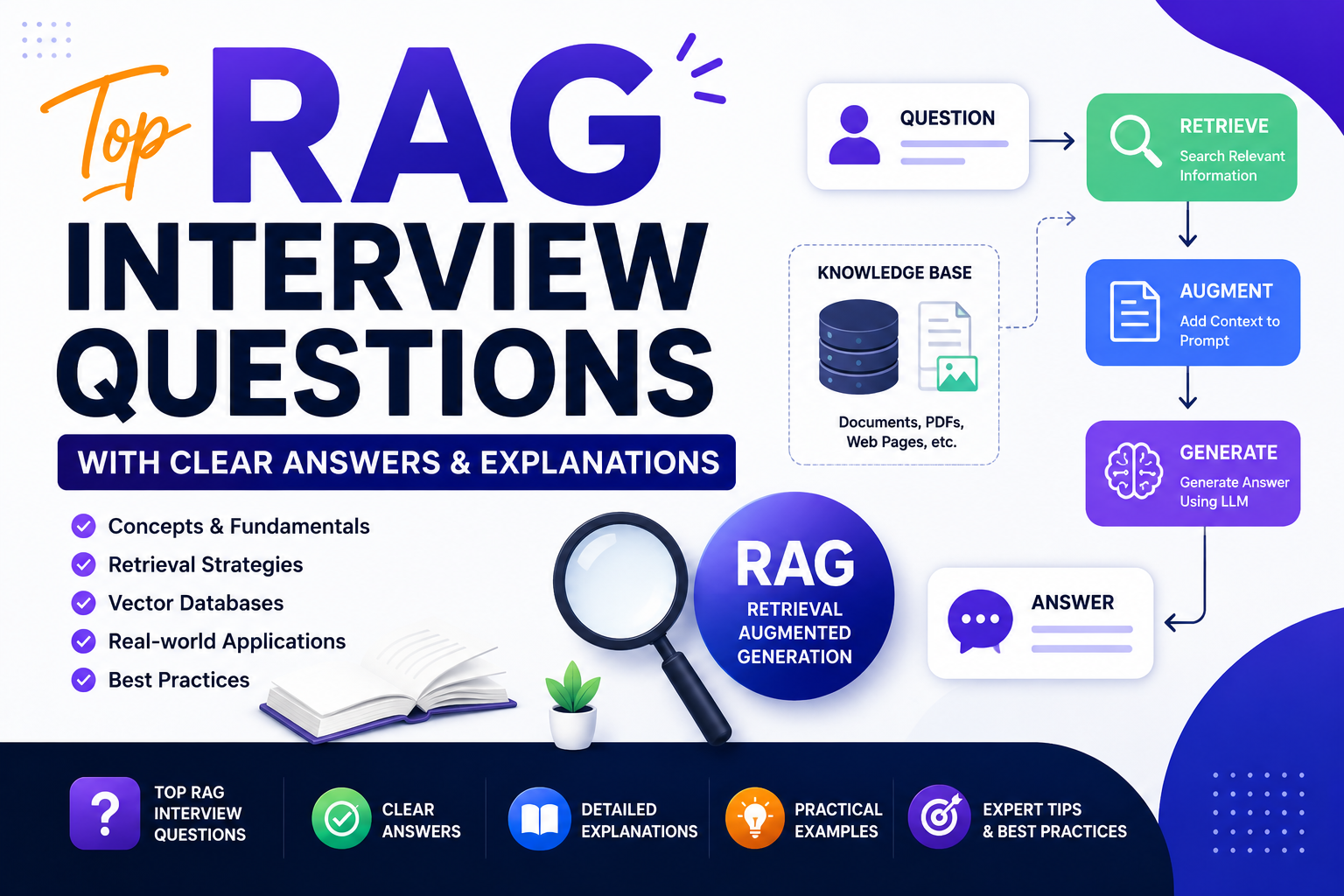
Q5: How do vector databases support AI and LLM applications? They play a central role in retrieval augmented generation: store document chunk embeddings, support low-latency retrieval based on a given query vector, and feed retrieved context into LLMs for grounded responses. Vector databases also support image and speech recognition applications and multi modal data retrieval.
Q6: Where does a vector database fit in a modern web/app stack? A typical architecture flows: data source → embedding model → vector storage → API/server → frontend. At Codex Junction, this powers use cases like semantic search on knowledge bases and product discovery for e-commerce clients.
Q7: What is the difference between vector storage and traditional row/column storage? Vectors are high dimensional vector embeddings stored as float arrays. Queries are query vector based nearest neighbor searches across a vector space model, not exact matches, structured queries, or relational joins over tabular data.
Key Differences: Vector DB vs Relational & NoSQL (Interview Basics)
Interviewers frequently check whether you understand when a vector database differ from relational or NoSQL options and when each is appropriate.
Q1: How does a vector database differ from a relational database like PostgreSQL? Relational databases have a rigid vector database schema of tables, columns, and SQL. Vector dbs use similarity APIs to search across high dimensional spaces. Traditional databases handle exact lookups and joins well; vector databases handle semantic relationships and fuzzy matching far better at scale.
Q2: Can I store embeddings in a traditional database? Yes-for small datasets, PostgreSQL with pgvector works. But without specialized indexing structures like HNSW or IVF, query performance degrades past a few million vectors. Dedicated vector databases win for large datasets.
Q3: How do vector databases compare to MongoDB or Elasticsearch? MongoDB focuses on JSON documents. Elasticsearch is a search-first engine with some vector features. Pure vector databases focus on fast, high dimensional nearest neighbor search with optimized ann algorithms and better recall-latency trade-offs.
Q4: When should you not use a vector database? Skip them for strict OLTP workflows, simple key-value lookups, heavy relational joins, or financial ledgers where exact matching on tabular data is critical.
Q5: What is a hybrid search system? Hybrid search combines full-text keyword matching (using an inverted file index) with vector similarity search. This yields search results that are both lexically and semantically relevant-standard practice in production search engines in 2025–2026.
Q6: How does an inverted file index differ from a vector index? An inverted index maps terms to document posting lists for exact keyword matching. A vector index uses search algorithms and data structures like HNSW or IVF to organize vectors for approximate nearest neighbor search across high dimensional data.
Similarity Search & Similarity Metrics: Core Algorithm Questions
Most vector database interviews test your understanding of similarity search and distance functions. Here’s what to prepare.
Q1: What is similarity search in the context of vector databases? Similarity search retrieves items close to a given query vector using a distance or similarity metric, returning the top-k most similar data points. Vector databases enable fast similarity search for high-dimensional data at scale.
Q2: What is nearest neighbor vs approximate nearest neighbor (ANN) search? Exact nearest neighbor guarantees finding the true closest results but is slow at scale. Approximate nearest neighbor search trades accuracy for speed in queries-ANN speeds up similarity searches significantly, often by 100× to 1,000× for millions of vectors. Approximate nearest neighbor search is used for quick approximate nearest neighbors in virtually all production systems.
Q3: Name common similarity metrics used in vector databases. | Metric | Description | Best For | |—|—|—| | Cosine similarity | Measures angle between vectors | Normalized text embeddings | | Euclidean distance | Geometric L2 distance | Image embeddings, raw vectors | | Inner product | Dot product alignment | Certain model outputs | | Manhattan (L1) | Sum of absolute differences | Specific sparse scenarios | | Jaccard similarity | Set overlap measure | Binary or categorical features |
Common distance metrics include euclidean distance and cosine similarity. The choice of similarity metrics directly affects search accuracy.
Q4: How do similarity metrics influence index choice? Graph-based indexes like HNSW work well with cosine and Euclidean metrics. IVF with product quantization is optimized for L2 or inner product distance. Locality sensitive hashing families must be tuned for specific metrics, making metric selection a key design decision.
Q5: Explain vector normalization and when to use it. Vector normalization scales vectors to unit length so that cosine similarity equals the dot product. This ensures similarity measures focus on direction, not magnitude-in other words, vector normalization ensures similarity depends on direction rather than vector length. Use it when semantic meaning matters more than embedding scale.
Q6: How would you evaluate retrieval quality of a similarity search system? Track recall@k, precision@k, latency percentiles (p50, p95, p99), and throughput (QPS). Offline benchmarks using labeled pairs or human relevance judgments validate search accuracy and retrieval quality.
Q7: How would you explain similarity search to a non-technical stakeholder? “It’s like finding similar songs by musical vibe or similar products by style-not just matching exact text, but finding things that feel similar based on semantic relationships.”

Indexing Strategies & Data Structures: HNSW, LSH, IVF & More
Senior interviews dig into indexing strategies and data structures that power vector search at scale. Indexing reduces the number of vectors compared during queries, which is essential for how does indexing work efficiently at production scale.
Q1: What is Hierarchical Navigable Small World (HNSW) and why is it popular? HNSW is a popular graph-based ANN algorithm that builds a multi-layer graph where each node connects to its neighbors. Queries traverse from the top sparse layer down to dense layers for high-recall retrieval. Benchmarks show HNSW achieves ~0.99 recall when properly tuned. It’s used in FAISS, Milvus, Qdrant, and Weaviate.
Q2: What is Locality Sensitive Hashing (LSH)? Locality sensitive hashing hashes vectors so that similar vectors collide in the same buckets with high probability, enabling fast approximate search. Trade-offs: faster lookups but more memory usage and generally lower search accuracy than HNSW in production setups.
Q3: What is an inverted file (IVF) index in vector search? IVF partitions the vector space into clusters using k-means centroids. At query time, only a few relevant clusters are searched (controlled by the nprobe parameter). Combined with product quantization, IVF scales to billion-vector datasets in systems like FAISS IVF-PQ.
Q4: Compare HNSW, IVF, and LSH. | Factor | HNSW | IVF (+PQ) | LSH | |—|—|—|—| | Recall | Very high (~0.99) | High with tuning | Moderate | | Memory | High (graph pointers) | Lower with PQ | Can be large | | Build time | Moderate-high | Clustering cost | Fast | | Best for | Real-time, high recall | Billion-scale, cost-sensitive | Simple implementations |
KD-trees and Ball-trees are also common indexing techniques for lower-dimensional data but struggle with high dimensional spaces.
Q5: What are key indexing strategies in popular vector databases? Milvus, Qdrant, Weaviate, and Pinecone typically offer HNSW-like graph indexes, IVF/PQ-based indexes, flat brute-force indexes, and GPU-accelerated FAISS options. These indexing techniques let you organize vectors for different latency and search speed requirements.
Q6: How does dimensionality reduction help indexing? High-dimensional data worsens performance due to the curse of dimensionality. Dimensionality reduction techniques like PCA and UMAP shrink vectors (e.g., from 1024 to 256 vector dimensions), reducing storage requirements for vector data and making similarity searches faster. Dimensionality reduction improves performance and reduces storage requirements, but you must monitor information loss carefully.
Q7: What’s the trade-off between rebuilding an index and incremental updates? Incremental updates are cheaper but may degrade index quality over time. Periodic rebuilds restore optimal graph or cluster structure, which is critical for large, frequently changing datasets where search speed and recall matter.
Popular Vector Databases & Ecosystem (With Concrete Examples)
Interviews often test tool familiarity, even if the role is vendor-agnostic.
Q1: Name some popular vector databases and libraries in 2025–2026. FAISS (Meta), Annoy (Spotify), Milvus, Qdrant, Weaviate, Pinecone, plus vector capabilities in Elasticsearch/OpenSearch and PostgreSQL pgvector.
Q2: How would you choose between FAISS and a hosted vector DB like Pinecone? FAISS is a C++/Python library offering tight control, GPU acceleration, and cost management. Pinecone or similar managed services simplify ops, scaling, backups, and SLAs but introduce vendor lock-in and per-query costs.
Q3: What are key considerations when picking a vector database for production?
- Latency requirements and search speed targets
- Data size (millions vs billions of vectors)
- Budget and cloud/on-prem needs
- Language SDKs and data pipelines integration
- Support for hybrid search, consistency, and security
Q4: Give an example of integrating a vector DB into a RAG system. Chunk a product documentation site into 500-token passages. Embed each chunk with an embedding model like OpenAI or Cohere. Store in Milvus or Qdrant. At query time, embed the user query, run similarity search, pass top-k chunks to an LLM to answer customer questions. This is how most rag systems work in practice.
Q5: How does Codex Junction use vector databases in client projects? We build semantic support search for SaaS clients, product recommendation for e-commerce sites, and internal knowledge search for consulting firms-all powered by vector DB infrastructure paired with our full-stack development capabilities.
Q6: What’s new in vector DBs since 2023? Tighter integration with LLM frameworks like LangChain and LlamaIndex, better hybrid search, GPU-native indexes, multi-tenant SaaS architectures, and emerging research like U-HNSW for universal Lp metrics.

Applied Use Cases: System Design & Scenario-Based Interview Questions
Many interviews shift from theory to “design a system that…” questions. Here’s how to approach them.
Q1: Design a semantic search system for 10 million documents. Choose an embedding model, define a chunking strategy (500-token windows), select HNSW indexing for high recall, add metadata filters (language, category), layer hybrid search with an inverted file index, implement caching, and target latency under 300 ms at p95.
Q2: How would you use a vector database in a recommendation engine? Store item embeddings (products, videos, courses). For each user interaction, run nearest neighbor queries to find similar products. They are used in recommendation systems to find similar products by comparing user and item embeddings in the same vector space model.
Q3: Describe how vector databases are used in anomaly detection. Model normal behavior as embeddings. New observations that land far from existing data points in high dimensional spaces are flagged as outliers. Anomaly detection systems set distance thresholds and tune for false positive rates.
Q4: How would you implement hybrid search for e-commerce? Combine keyword matching on product titles (inverted index) with vector similarity on product and query embeddings. Rerank merged search results using relevance scores and business rules like stock levels or margins.
Q5: Explain the role of vector DBs in RAG systems powering chatbots. Vector databases enable semantic search in customer support systems through this loop: embed user query → fast similarity search over document chunks → feed retrieved context into LLM → generate grounded answer. This is the backbone of most 2025–2026 customer support bots.
Q6: What are key considerations when exposing vector search via an API? Pagination, top-k limits, metadata filters, multi-tenant isolation across multiple nodes, rate limiting, and monitoring latency, recall, and error rates.
Performance, Scaling & Operations: Practical Engineering Questions
These DevOps-oriented questions show you understand real-world constraints beyond theory.
Q1: What challenges arise when scaling to billions of vectors? Vector databases face challenges in managing large-scale data efficiently: memory pressure, long index build times, distributed sharding across multiple nodes, replication overhead, and maintaining low latency under high QPS.
Q2: How do you monitor and debug performance? Track p95/p99 latency, recall@k on held-out queries, CPU/GPU utilization, index size, memory usage, and cache hit rates. Run regular load testing against baseline benchmarks to catch query performance regressions.
Q3: How do you handle updates and deletes in vector indexes? Most systems use soft deletes with background compaction. Some support in-place updates; others prefer batch operations followed by index rebuilds. Timestamps help manage consistency in data pipelines.
Q4: What is vector quantization and how does it help? Vector quantization techniques like Product Quantization (PQ) and OPQ compress vectors into compact codes, reducing memory usage and accelerating searches at the cost of some accuracy. FAISS IVF-PQ is a widely used real-world example. Dimensionality reduction helps make similarity searches faster alongside quantization.
Q5: How would you reduce latency for a high-traffic similarity search API? Use HNSW or IVF indexes, cache top results, limit vector dimensions via dimensionality reduction techniques, leverage GPU acceleration, and colocate the vector DB near application servers for minimal network overhead.
Q6: What trade-offs do you make between latency and accuracy? Tune parameters like ef_search (HNSW) or nprobe (IVF). Higher values improve recall but increase latency. The right balance depends on whether the use case is mission-critical (medical search) or best-effort (content recommendation). Approximate nearest neighbor search trades accuracy for speed in queries-the key is calibrating that trade-off.
Q7: How do you ensure reliability and disaster recovery? Replication across multiple nodes, regular snapshots and backups, multi-AZ or multi-region deployment, and scheduled restore drills ensure durability and availability.
Security, Privacy & Governance in Vector Databases
As vector databases store sensitive customer and business data, interviewers increasingly touch on security and compliance.
Q1: What are the main security measures for a production vector database? Authentication (API keys, OAuth), authorization (RBAC), TLS in transit, data encryption at rest, network isolation (VPC/Private Link), and audit logging.
Q2: How can embeddings leak sensitive information? Embeddings may encode PII or confidential data even though they appear as numbers. Model inversion attacks can theoretically reconstruct input data. Input sanitization and data minimization are essential.
Q3: How do you protect data in a multi-tenant vector DB? Use per-tenant collections or namespaces, row-level filtering, separated indexes, and strict access control boundaries to prevent cross-tenant leakage.
Q4: What’s the role of anonymization and differential privacy? Masking identifiers, aggregating vectors, or training models with differential privacy techniques protect sensitive data in regulated domains like healthcare or finance.
Q5: How would you explain GDPR/CCPA compliance concerns with vector data? Support right to erasure (delete from vector DB and backups), enforce data residency requirements, and document all data flows involving embeddings through your data pipelines.
Q6: How does Codex Junction approach security for vector search implementations? We use secure cloud architectures, least-privilege IAM, encrypted storage, and ongoing monitoring as standard delivery practices for every client engagement.
Interview Prep Tips for Freshers: How to Study Vector Databases Smartly
You don’t need PhD-level math to answer most vector database interview questions. Solid conceptual understanding and hands-on practice are enough to stand out.
Start with basics of vectors and embeddings. Learn high-level linear algebra-dot products, cosine, norms-and experiment with a simple embedding model in Python. Understanding how machine learning model outputs become high dimensional vector embeddings is foundational.
Build a tiny similarity search demo. Take a set of FAQ questions, create embeddings using an API, index them in a lightweight vector DB like Qdrant or pgvector, and implement a semantic search endpoint. Nothing impresses interviewers like a working project.
Practice explaining concepts simply. Rehearse 2–3 sentence answers to core questions: “What is a vector database?”, “What is similarity search?”, “What is HNSW?” Clarity beats complexity.
Revise ecosystem and terminology. Know names like FAISS, Milvus, Pinecone, HNSW, LSH, IVF, hybrid search, and RAG system so you can discuss key considerations confidently.
Connect vector databases to web/app dev and SEO use cases. Semantic site search, content recommendation, and AI-assisted chatbots all rely on vector databases-making this knowledge directly relevant to digital marketing and IT projects.

Consistent practice, a mini-project, and reading the official docs of at least one popular vector database will set you apart. Start building a small semantic search demo today-it’s the fastest path from theory to interview confidence.
Comments